
Chapter 7 - Graph

Hare Fuyukawa Lv4

定义

注意

补充、解释

其他

1 Definition

Definition

图(Graph)由顶点集合V和边集合E构成,其中顶点集不能为空,每条边一定要有两个端点
想象一个三角形ABC,这个图的顶点集合就是{A,B,C}
边集合就是{AB,AC,BC}

Undirected Graph: 边AB代表着A可以到B,B也可以到A
Directed Graph: 边A->B和边B->A是两条边
无向图的边用圆括号表示,如(A,B)
有向图的边用尖括号表示,如<A,B>,代表从A指向B,它不等于<B,A>

图的边不会重复,比如对有向图,从A到B就只有一条边,也不会出现自己指向自己的边

Complete graph(完全图): a graph that has the maximum number of edges
对于个顶点的有向完全图,有条边,或说个顶点的有向图最多有条边
对于个顶点的无向完全图,有条边

无图中,两个顶点间有条边,称 and are adjacent
有向图中,从指向,称 is adjacent to ; is adjacent from

Degree(度): number of edges incident to v.For a directed G, we have in-degree and out-degree.

对于无向图,一条边贡献两个度,所以各顶点度之和等于边数乘2
对于有向图,一条边贡献一个出度一个入度,各顶点出度之和等于各顶点入度之和等于图的总边数,同时各顶点度之和等于边数乘2

Path from to ::= { , , , …, , } such that ( , ), ( , ), …, ( , ) or < , >, …, < , > belong to E( G )

Length of a path : number of edges on the path

Simple path : 走过的顶点不重复
Cycle ::= simple path with =
Subgraph: 图的一部分,它仍是一个图

and in an undirected G are connected if there is a path from to (and hence there is also a path from to )

An undirected graph G is connected if every pair of distinct vi and vj are connected

(Connected) Component of an undirected G ::= the maximal connected subgraph
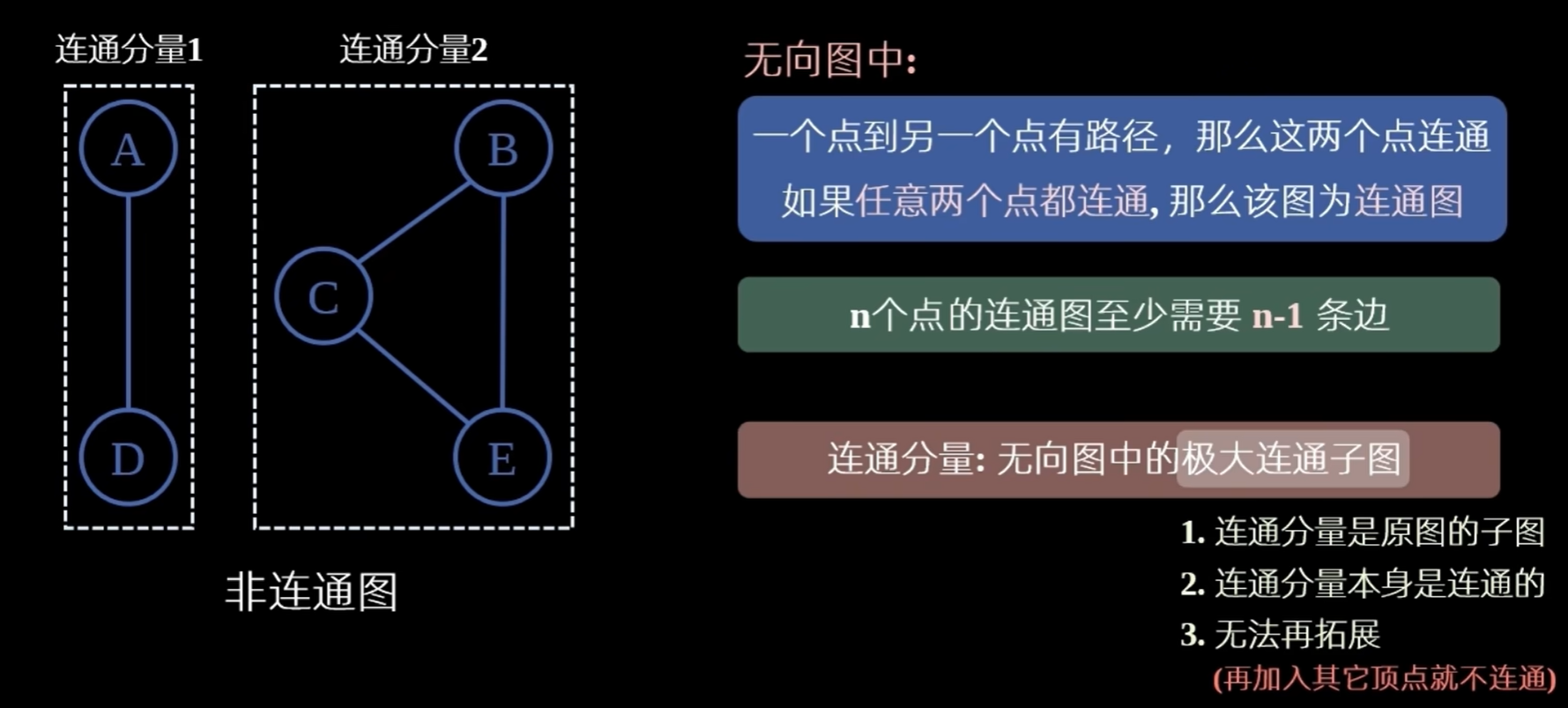
图来自b站up主蓝不过海牙的视频,up主简介里写禁止搬运/二改,不知是否可以截图用于非商用笔记,若有侵权我会立刻删除!
视频链接
图中单选BE也是连通图,但不是最大,如果选CBEA,就不连通了,连通图就只有自己这一个连通分量

Strongly connected directed graph G ::= for every pair of vi and vj in V( G ), there exist directed paths from vi to vj and from vj to vi. If the graph is connected without direction to the edges, then it is said to be weakly connected

Strongly connected component ::= the maximal subgraph that is strongly connected

对无向图,n个顶点的连通图至少要n-1条边(一排)
有向图,n个顶点的强连通图至少要n条边
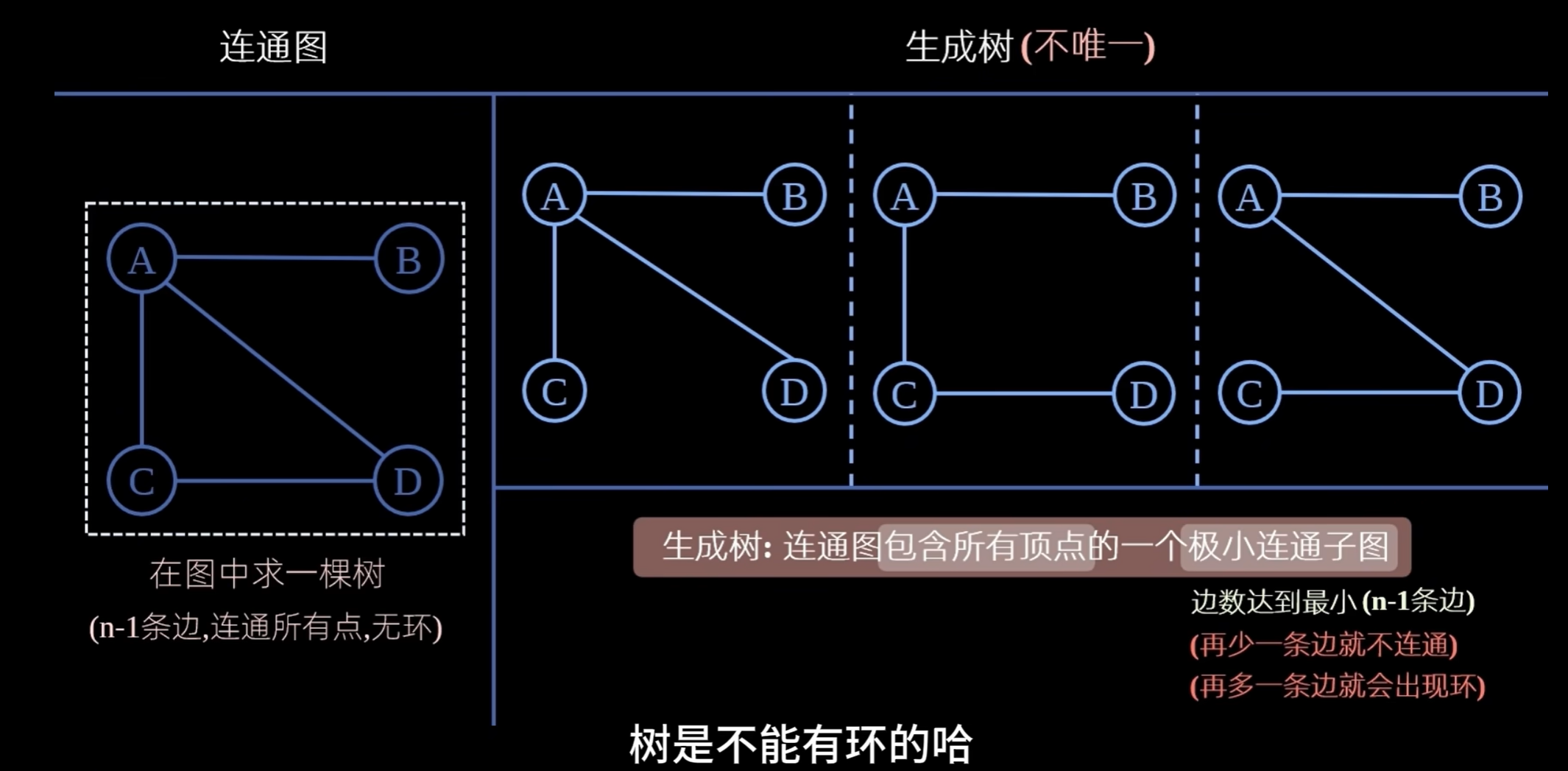
图来自b站up主蓝不过海牙的视频,up主简介里写禁止搬运/二改,不知是否可以截图用于非商用笔记,若有侵权我会立刻删除!
视频链接

2 Representation of Graphs

2.1 Adjacency Matrix

用一个二维数组来存储图,
a[i][j]=1表示i邻接到j
a[j][i]=1表示i邻接自j
可见对无向图,这个矩阵是对称的,我们可以把下三角矩阵一行一行遍历,存成一个一维数组

优点:

  • 容易判断两个顶点是否邻接
  • 容易计算顶点的度,对行求和得到出度,对列求和得到入度,对于无向图,对行/列任一求和得到度,

缺点:

  • 统计边数量很难,要遍历整个矩阵,
  • 空间复杂度高
1
2
3
4
5
6
7
8
9
10
11
12
13
14
15
16
17
18
19
20
21
22
23
24
25
26
27
28
29
30
31
32
33
34
35
36
37
38
39
40
41
42
43
44
45
46
47
48
49
50
51
52
53
54
55
56
/*以下代码由ai生成*/

#define MAXV 100 // 最大顶点数,根据题目要求调整
#define INF 0x3f3f3f3f // 表示无穷大(带权图无边时用)
// 顶点数据类型,根据题目修改(这里用int)
typedef int VertexType;
// 边权值类型,根据题目修改(这里用int)
typedef int WeightType;

// 邻接矩阵表示的图
typedef struct {
VertexType vex[MAXV]; // 顶点表
WeightType edge[MAXV][MAXV];// 邻接矩阵(边表)
int numVex; // 顶点数
int numEdge; // 边数
} MGraph;

// 初始化一个有n个顶点的空图
void InitMGraph(MGraph* G, int n) {
G->numVex = n;
G->numEdge = 0;

// 初始化顶点表
for (int i = 0; i < n; i++) {
G->vex[i] = i; // 默认顶点编号为0,1,2,...,n-1
}

// 初始化邻接矩阵
for (int i = 0; i < n; i++) {
for (int j = 0; j < n; j++) {
if (i == j)
G->edge[i][j] = 0; // 自己到自己的距离为0
else
G->edge[i][j] = INF; // 无边时为无穷大
//不带权值,赋成0就行了
}
}
}

// 添加一条从v到u的边,权值为w
// 无向图需要调用两次:AddMEdge(G, v, u, w) 和 AddMEdge(G, u, v, w)
void AddMEdge(MGraph *G, int v, int u, WeightType w) {
// 边界检查
if (v < 0 || v >= G->numVex || u < 0 || u >= G->numVex) {
printf("顶点编号错误!\n");
return;
}

G->edge[v][u] = w;
G->numEdge++;
}

// 简化版:添加无权图的边(权值默认为1)
void AddMEdgeUnweighted(MGraph *G, int v, int u) {
AddMEdge(G, v, u, 1);
}

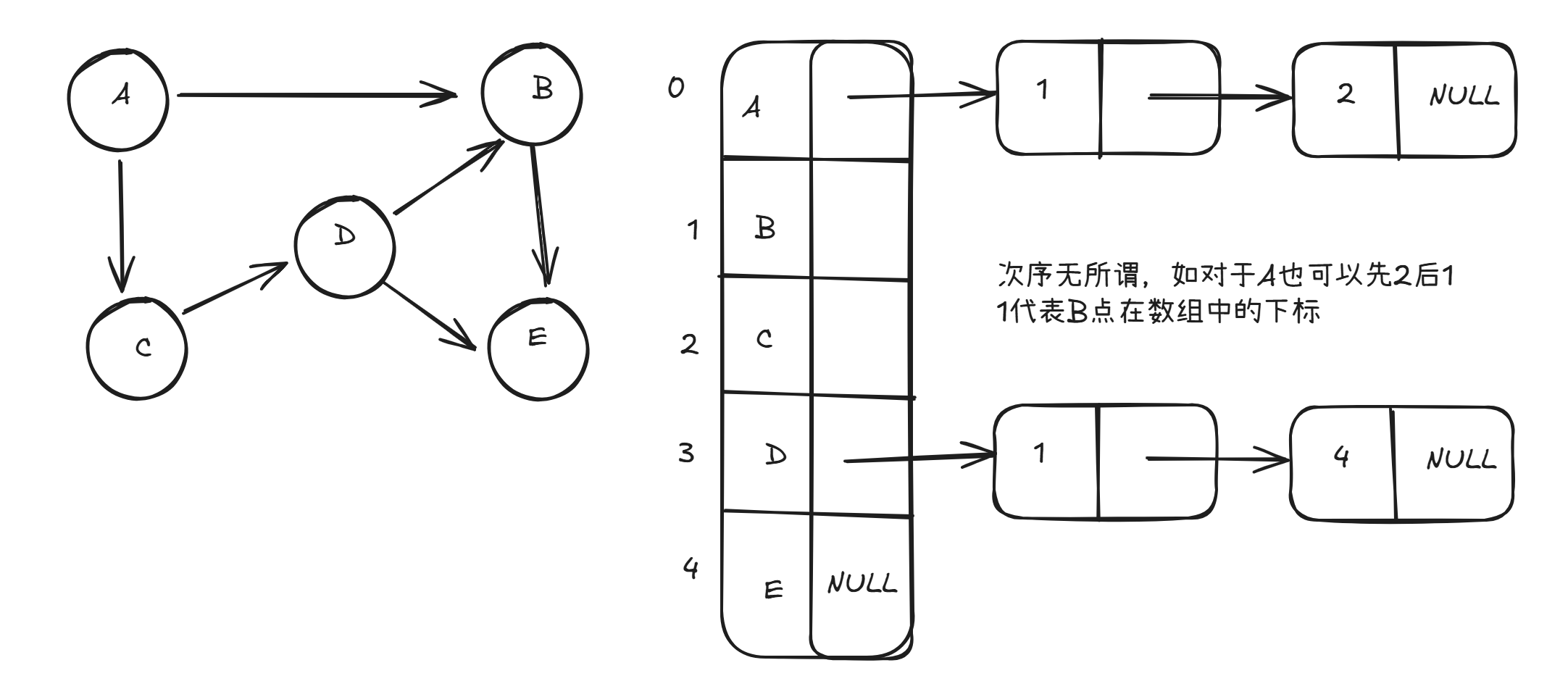
2.2 Adjacency Lists


对于无向图,空间 heads + nodes
对于无向图,一个顶点的度就是它这个链表的结点数
有向图遍历所有边的时间复杂度是,无向图是

有向图我们需要知道入度,所以需要Inverse Adjacency List,每个顶点存指向它的边,整体和上面的表一样

1
2
3
4
5
6
7
8
9
10
11
12
13
14
15
16
17
18
19
20
21
22
23
24
25
26
27
28
29
30
31
32
33
34
35
36
37
38
39
40
41
42
43
44
45
46
47
48
49
50
51
52
53
54
55
56
57
58
59
60
61
62
63
64
65
66
67
68
69
70
71
72
73
/*以下代码由ai生成*/

// 边节点
typedef struct EdgeNode {
int adjvex; // 邻接点的下标
WeightType weight; // 边的权值(无权图可省略,但建议保留)
struct EdgeNode *next; // 指向下一个边节点
} EdgeNode;

// 顶点节点
typedef struct VertexNode {
VertexType data; // 顶点的数据
EdgeNode *firstedge; // 指向第一个边节点
} VertexNode, AdjList[MAXV];
//

// 邻接表表示的图
typedef struct {
AdjList adjlist; // adjlist是长度为 MAXV 的 VertexNode 数组类型
int numVex; // 顶点数
int numEdge; // 边数
} ALGraph;

// 初始化一个有n个顶点的空图
void InitALGraph(ALGraph *G, int n) {
G->numVex = n;
G->numEdge = 0;

// 初始化顶点表
for (int i = 0; i < n; i++) {
G->adjlist[i].data = i; // 默认顶点编号为0,1,2,...,n-1
G->adjlist[i].firstedge = NULL; // 关键:初始化为空指针
}
}

// 添加一条从v到u的边,权值为w
// 无向图需要调用两次:AddALEdge(G, v, u, w) 和 AddALEdge(G, u, v, w)
void AddALEdge(ALGraph *G, int v, int u, WeightType w) {
// 边界检查
if (v < 0 || v >= G->numVex || u < 0 || u >= G->numVex) {
printf("顶点编号错误!\n");
return;
}

// 创建新的边节点
EdgeNode *newEdge = (EdgeNode *)malloc(sizeof(EdgeNode));
newEdge->adjvex = u;
newEdge->weight = w;
// 头插法:插入到链表头部
newEdge->next = G->adjlist[v].firstedge;
G->adjlist[v].firstedge = newEdge;

G->numEdge++;
}

// 简化版:添加无权图的边(权值默认为1)
void AddALEdgeUnweighted(ALGraph *G, int v, int u) {
AddALEdge(G, v, u, 1);
}

void DestroyALGraph(ALGraph *G) {
for (int i = 0; i < G->numVex; i++) {
EdgeNode *p = G->adjlist[i].firstedge;
while (p != NULL) {
EdgeNode *temp = p;
p = p->next;
free(temp);
}
G->adjlist[i].firstedge = NULL;
}
G->numVex = 0;
G->numEdge = 0;
}

对于有向图,同时表示出度和入度,还可以使用十字链表
(画图耗时间,但莫名地喜欢)
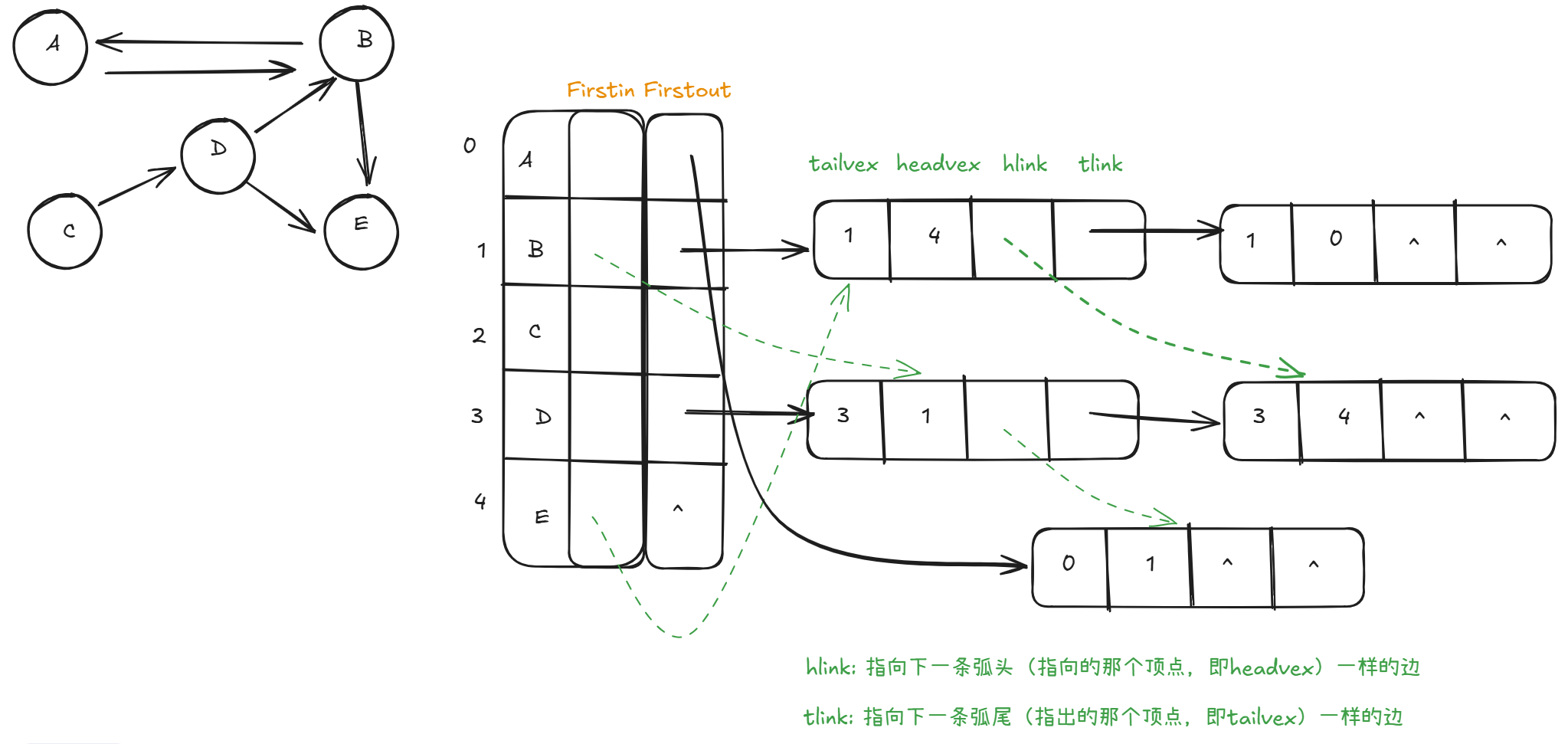
对于B,“竖着”的部分就代表入度,“横着”的部分代表出度,我们采用头插法,所以不用担心不知道什么时候判断出/入的边统计完了

代码实现就挖坑罢(

2.3 Adjacency Multilists
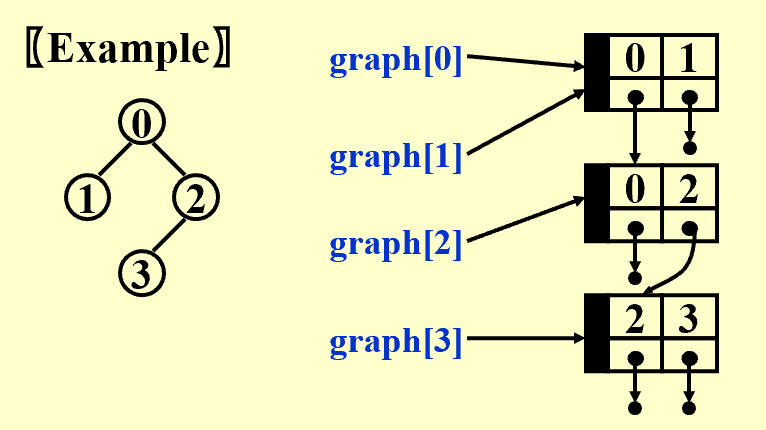

适用于无向图,如果要标记某条边会方便些,好吧其实我现在也不清楚它的应用
右边的块是边,每个块有这个边的两个结点和两个指针,如第一个结构,0的指针指向下一个有0的边,1的指针同理

3 AOV and Topological Order

引入:
顶点:表示一门课程(活动)
有向边 <C1, C3>:表示 C1 是 C3 的先修课(C1 必须在 C3 之前完成)
比如:
你必须先学《高等数学》,才能学《线性代数》
你必须先学《C 语言》,才能学《数据结构》

AOV 网(Activity On Vertex Network)
顶点表示活动(Activity),有向边表示活动之间的前驱关系的有向图。
边 <i, j> 表示:活动 i 是活动 j 的直接前驱(immediate predecessor),活动 j 必须在活动 i 完成后才能开始
活动 i 是活动 j 的前驱(predecessor):存在一条从 i 到 j 的路径(不一定是直接边)
活动 j 是活动 i 的后继(successor):对应前驱的反向关系

偏序关系(Partial Order) = 传递性 + 反自反性
可行的 AOV 网一定是 DAG(有向无环图 directed acyclic graph

Definition

A topological order (拓扑排序) is a linear ordering of the vertices of a graph such that, for any two vertices, i, j, if i is a predecessor of j in the network then i precedes j in the linear ordering.

The topological orders may not be unique for a network.

算法就是每次找到入度为0的点(当前优先级最高),删除这个顶点和它的所有(出去的)边,然后重复步骤直到AOV网中没有入度为0的顶点或AOV网中没有顶点

1
2
3
4
5
6
7
8
9
10
11
12
13
14
15
16
void Topsort(Graph G) {
int Counter;
Vertex V, W;
for (Counter = 0; Counter < NumVertex; Counter++) {
// 每次遍历所有顶点,找一个入度为0的顶点
V = FindNewVertexOfDegreeZero();
if (V == NotAVertex) {
Error("Graph has a cycle"); // 找不到入度为0的顶点,说明有环
break;
}
TopNum[V] = Counter; // 记录拓扑序号
// 删除V的所有出边:所有邻接点的入度减1
for (each W adjacent from V)
Indegree[W]--;
}
}

每次找入度为 0 的顶点都要遍历所有 n 个顶点,总时间复杂度 O (n²),效率低。

改进:

  1. 计算所有顶点的入度,将入度为 0 的顶点入队(或用stack也可以,那么就是push)
  2. 当队列不为空时:
    出队一个顶点 V,记录它的拓扑序号
    遍历 V 的所有邻接点 W,将 W 的入度减 1
    如果 W 的入度变为 0,将 W 入队
  3. 如果最终记录的顶点数小于总顶点数,说明图中有环
1
2
3
4
5
6
7
8
9
10
11
12
13
14
15
16
17
18
19
20
21
22
23
24
25
26
27
28
29
30
31
void Topsort(Graph G) {
Queue Q;
int Counter = 0;
Vertex V, W;

// 1. 创建并初始化队列
Q = CreateQueue(NumVertex);
MakeEmpty(Q);

// 2. 遍历所有顶点,将入度为0的顶点入队
for (each vertex V)
if (Indegree[V] == 0)
Enqueue(V, Q);

// 3. 处理队列中的顶点
while (!IsEmpty(Q)) {
V = Dequeue(Q);
TopNum[V] = ++Counter; // 分配拓扑序号(从1开始)

// 遍历V的所有邻接点,入度减1
for (each W adjacent from V)
if (--Indegree[W] == 0)
Enqueue(W, Q);
}

// 4. 判断是否有环
if (Counter != NumVertex)
Error("Graph has a cycle");

DisposeQueue(Q); // 释放队列内存
}

初始计算每个点的入度,要遍历整个图,
删除当前入度为0的点的边,只要AOV网能进行拓扑排序,所有顶点都会经历,,每个点还会入队/出队,
时间复杂度为

下面以邻接表为例实现

1
2
3
4
5
6
7
8
9
10
11
12
13
14
15
16
17
18
19
20
21
22
23
24
25
26
27
28
29
30
31
32
33
34
35
36
37
38
39
40
41
42
43
44
45
46
47
48
49
50
51
52
53
54
55
56
57
58
59
60
61
62
63
64
65
66
67
68
69
70
71
72
73
74
75
76
77
78
79
80
81
82
83
84
85
86
87
88
89
90
91
92
93
94
95
96
97
98
99
100
101
102
103
104
105
// 边节点
typedef struct EdgeNode {
int adjvex; // 邻接点的下标
WeightType weight; // 边的权值(无权图可省略,但建议保留)
struct EdgeNode *next; // 指向下一个边节点
} EdgeNode;

// 顶点节点
typedef struct VertexNode {
VertexType data; // 顶点的数据
EdgeNode *firstedge; // 指向第一个边节点
} VertexNode, AdjList[MAXV];
//

// 邻接表表示的图
typedef struct {
AdjList adjlist; // adjlist是长度为 MAXV 的 VertexNode 数组类型
int numVex; // 顶点数
int numEdge; // 边数
} ALGraph;

typedef struct {
int data[MAXV];
int front, rear;
} Queue;

// 初始化队列
void InitQueue(Queue *Q) {
Q->front = Q->rear = 0;
}

// 判断队列是否为空
int IsEmpty(Queue *Q) {
return Q->front == Q->rear;
}

// 入队
void Enqueue(Queue *Q, int v) {
Q->data[Q->rear++] = v;
}

// 出队
int Dequeue(Queue *Q) {
return Q->data[Q->front++];
}


void CalcInDegree(ALGraph *G, int Indegree[]) {
for(int i = 0;i<G->numVex;++i)
{
Indegree[i] = 0;
} //初始化

for(int i = 0;i<G->numVex;++i)
{
EdgeNode* p = G->adjlist[i].firstedge;
while(p!=NULL)
{
Indgree[p->adjvex]++;
p = p->next;
}
}

}

int Topsort(ALGraph *G, int TopNum[]) {
Queue q;
int Indegree[MAXV];
int count = 0; // 多少个顶点已排序
InitQueue(&q);
CalcInDegree(G, Indegree);
int v = 0;
int tmp = 0;
for(v = 0;v<G->numVex;++v)
{
if(Indegree[v] == 0)
{
Enqueue(&q,v);
}
}

while(!IsEmpty(&q))
{
v = Dequeue(&q);
TopNum[count++] = v;
EdgeNode* p = G->adjlist[v].firstedge;
while(p!=NULL)
{
// 删除该顶点所有边
tmp = p->adjvex;
if(--Indegree[tmp] == 0)
{
Enqueue(&q,tmp);
}
p = p->next;
}
}

if(count != G->numVex)
{
puts("Not DAG, there exists a circle !");
return 0;
}
return 1;
}
  • Title: Chapter 7 - Graph
  • Author: Hare Fuyukawa
  • Created at : 2026-04-25 21:00:59
  • Updated at : 2026-06-03 17:38:49
  • Link: https://redefine.ohevan.com/Data-Structure/DS/FDS-8/
  • License: This work is licensed under CC BY-NC-SA 4.0.
Comments