Chapter 8 - Advanced Counting Techniques

定义
注意
补充、解释
其他
本章全程高能(
1 Applications of Recurrence Relations
“这种题找递推关系是最难的一步”
We distinguish them by the initial conditions, the values of a0 , a1 , a2 , … to uniquely identify a sequence.
例如$C(n+1,k)=C(n,k)+C(n,k-1)$
我们要定义C(n,0)和C(n,1) (和非法组合数为0)
【Example】A young pair of rabbits is placed on an island. A pair of rabbits does not breed until they are 2 months old. After they are 2 months old, each pair of rabbits produces another pair each month. Find a recurrence relation for the number of pairs of rabbits on the island after n months, assuming that no rabbits ever die.
$f_0 = 1$
$f_1 = 1$
n个月后,原先有$f_{n-1}$对,新出生的$f_{n-2}$对,因为$f_{n-2}$代表两个月前的兔子对数,这些对兔子现在都能生育了
$$f_{n} = f_{n-1} + f_{n-2}$$
【Example】Let $H_n$ denote the number of moves needed to solve The Tower of Hanoi problem with n disks H1 , H2 , … , Hn , …
汉诺塔的任务是三个杆,把n个盘从1号运到2号
先把n-1个盘运到3号,再把底下的盘运到2号,再把n-1个盘运回2号
$$H_n = 2H_{n-1} + 1$$
$H_1=1$,两边同时+1即可解得$H_n = 2^n-1$
这个算法看上去很简单易懂,其实没那么显然……
【Example】Find a recurrence relation for the number of bit strings of length n that don’t have two consecutive 0s.
如果这个长度为n的字符串最后一位是1,那么只有$a_{n-1}$个
如果结尾是10,那么只有$a_{n-2}$个
这已经涵盖了所有情况,因为末两位只能是11,10,01
$$a_n = a_{n-1} + a_{n-2}, n\ge 3$$
$a_1 = 2,a_2=3$
2 Solving Linear Recurrence Relations
这让我想起我高中时的一位数学老师
2.1 Linear homogeneous recurrence relation of degree k with constant coefficients
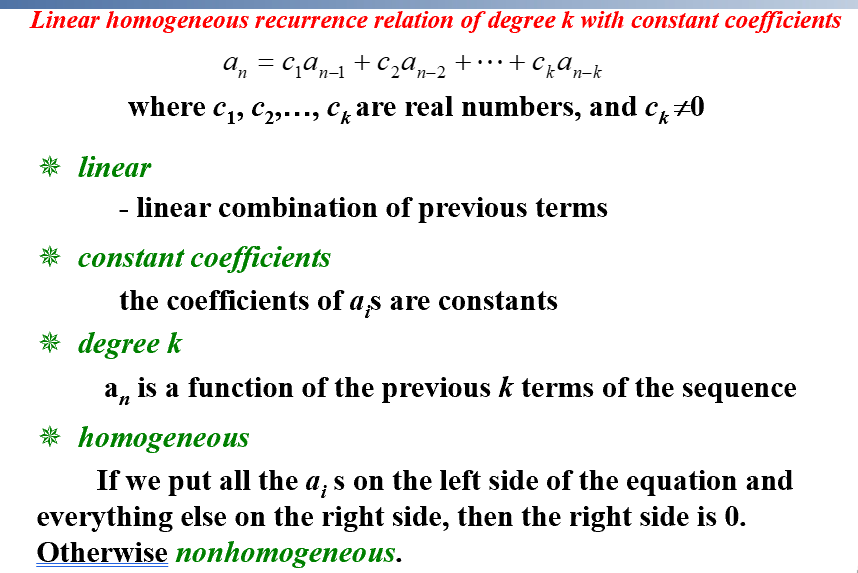
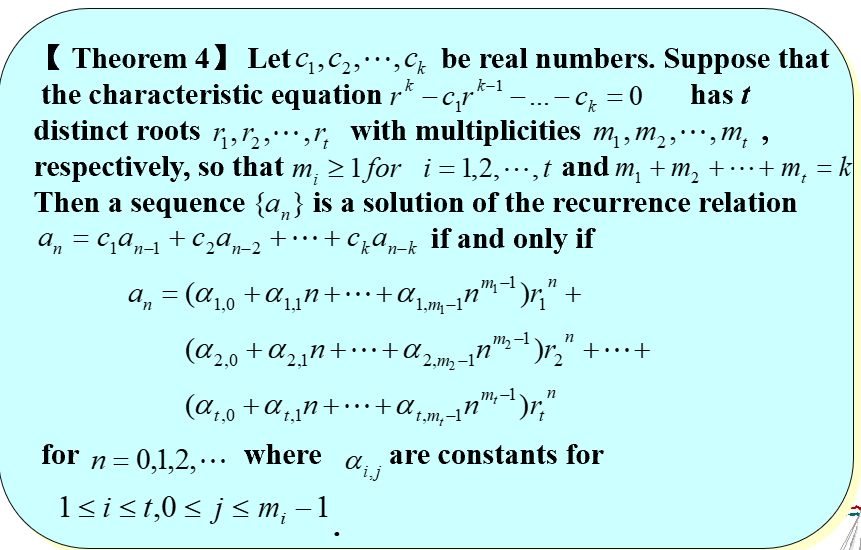
把$a_i$换成$r^i$
得到characteristic equation
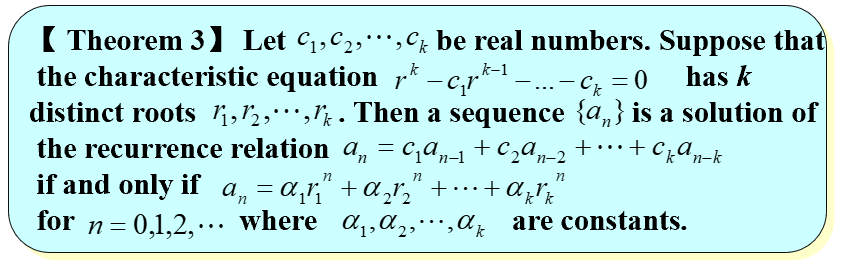
$$r^k-c_1r^{k-1}-…-c_k=0$$
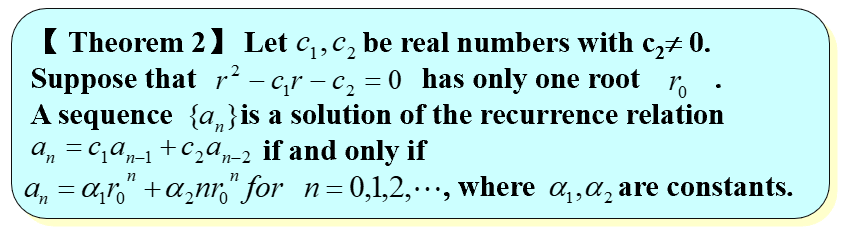
得到k个characteristic root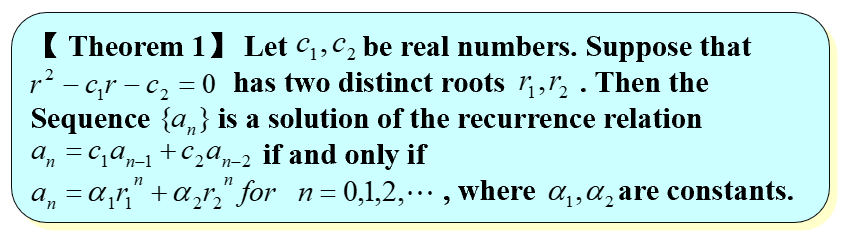
证明:
首先将这个形式代入递推式,再利用$r_1^2=c_1r_1+c_2$,是符合的
利用初始条件解出α,根据递推的唯一性(归纳法证明),若an是解,可以写成这种形式
2.2 Linear Nonhomogeneous Recurrence Relation With Constant Coefficients
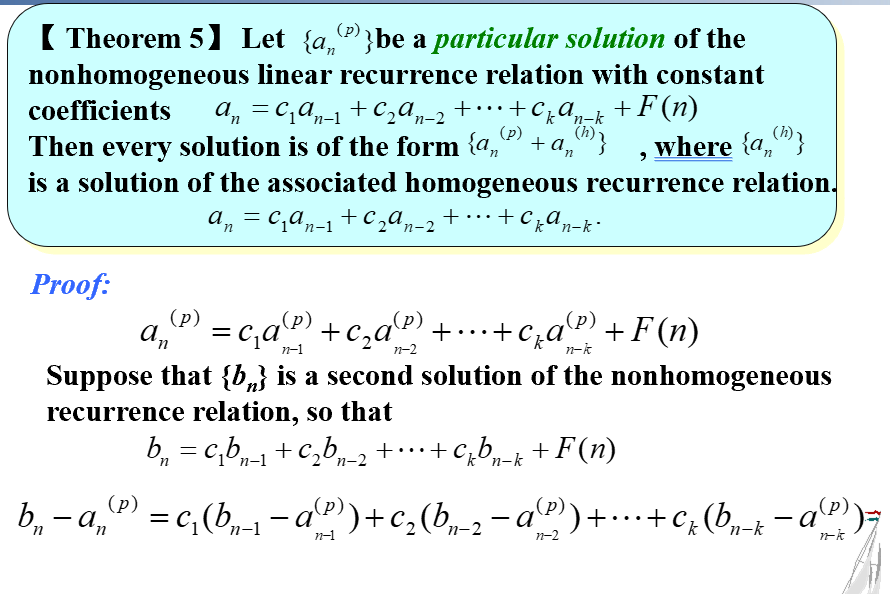
怎么想到了线性代数?
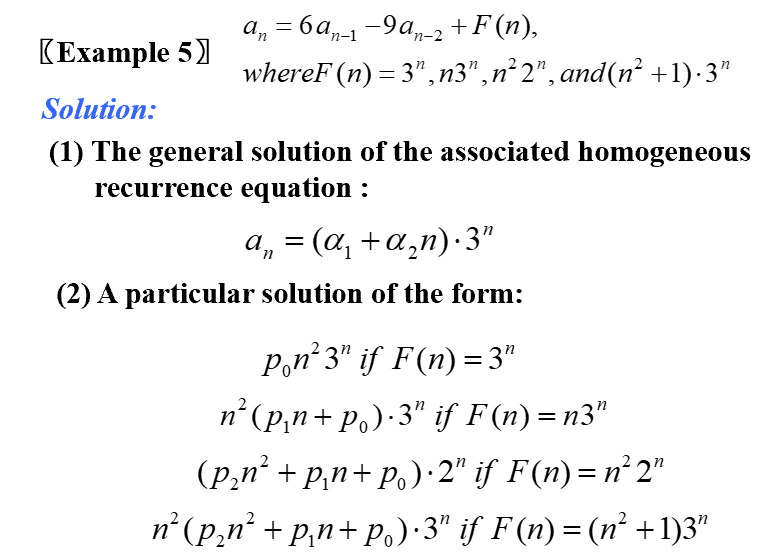
特解的形式,注意s=1的情况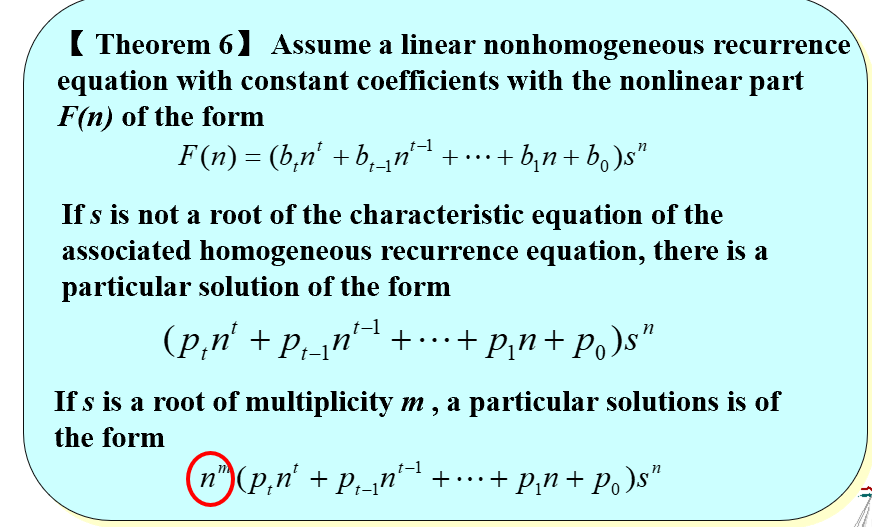
3 Generating Functions
期中考之前,我还挺喜欢级数的,好吧,现在也挺喜欢的
The generating function for the sequence $a_0,a_1,…,a_k,…$ of real numbers is the infinite series
$$G(x) = a_0 + a_1x + .. + a_kx^k + … = \sum_{k=0}^\infty a_kx^k$$
例如,数列1,1,1,1,1,…的生成函数是
$$G(x)=1+x+x^2+…=\sum_{k=0}^\infty x^k = \frac{1}{1-x} $$
其中$\mid x\mid < 1$
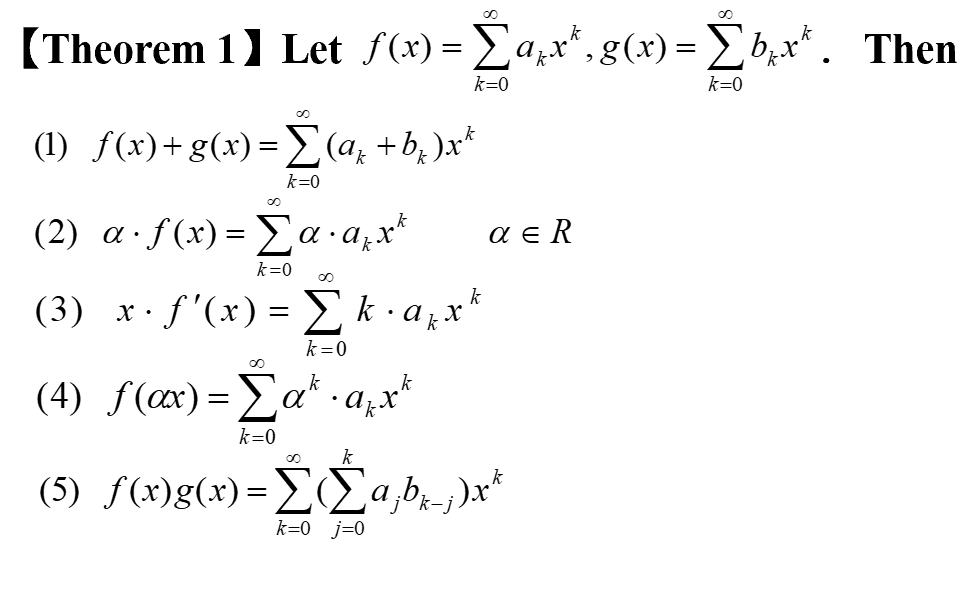
【1】What is the generating function for the sequence 0,1,2,3,4,…
$$G(x) = \sum_{k=0}^\infty kx^k = x\sum_{k=1}^\infty kx^{k-1} = x(\frac{x}{1-x})’ = \frac{x}{(1-x)^2}$$
【2】Suppose that the generating function of the sequence: $a_0,a_1,,…,a_n,…$ is G(x). What is the generating function for the sequence $b_k = \sum_{i=0}^k a_i$
$$c_k = 1$$
$$b_k = \sum_{i=0}^k a_i = \sum_{i=0}^k a_ic_{k-i}$$
$$F(x) = G(x) \frac{1}{1-x}$$
所以上一题也可以这么做:
$a_k = 1$
$b_k = \sum_{i=0}^k a_i$
$$G(x) = xF(x) = x(\frac{1}{1-x})^2$$
【3】What is the generating function for the sequence $a_k = k^2$
$x+2x^2+3x^3+4x^4+… = \frac{x}{(1-x)^2}$
$$x+4x^2+9x^3+16x^4+… = x(1+4x+9x^2+16x^3+…)$$
$$G(x) = x(\frac{x}{(1-x)^2})’ = \frac{x(1+x)}{(1-x)^3}$$
【4】What is the generating function for the sequence $a_k = \sum_{i=0}^k i^2$?
$b_k = 1$
$c_k = k^2$
$$a_k = \sum_{i=0}^k c_ib_{k-i}$$
$$G(x) = \frac{x(1+x)}{(1-x)^4}$$
【5】$f(x) = \frac{1}{1-4x^2}$. Find the coefficient $a_0,a_1,…$ in the expansion $$f(x)=\sum^{\infty}_{k=0} a_kx^k$$
$$f(x) = \frac{1}{2}(\frac{1}{1-2x}+\frac{1}{1+2x})$$
$$a_k = \frac{1}{2}(2^k+(-2)^k)$$
3.1 The extended binomial coefficient
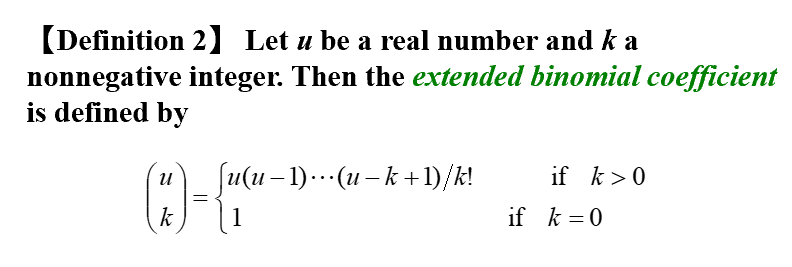
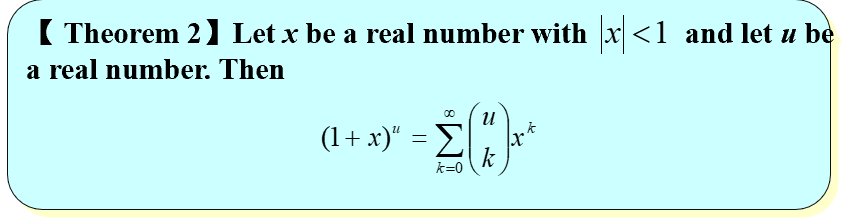
请利用上面的定理证明下图中的7,8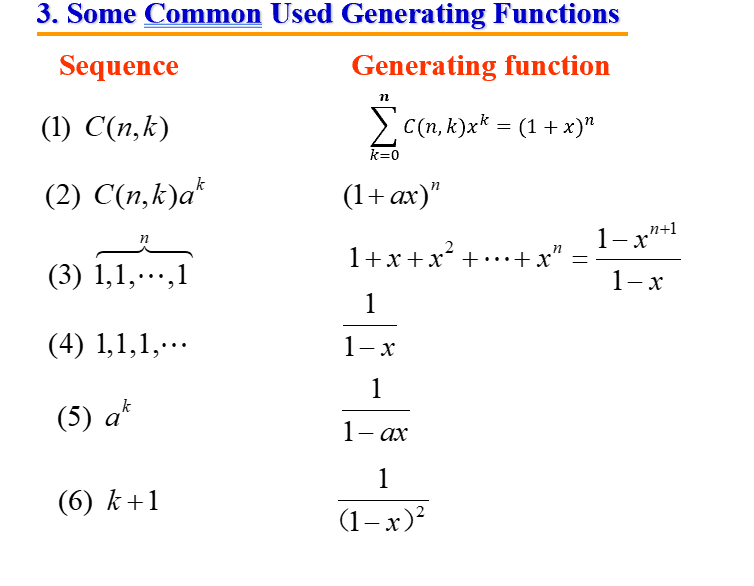
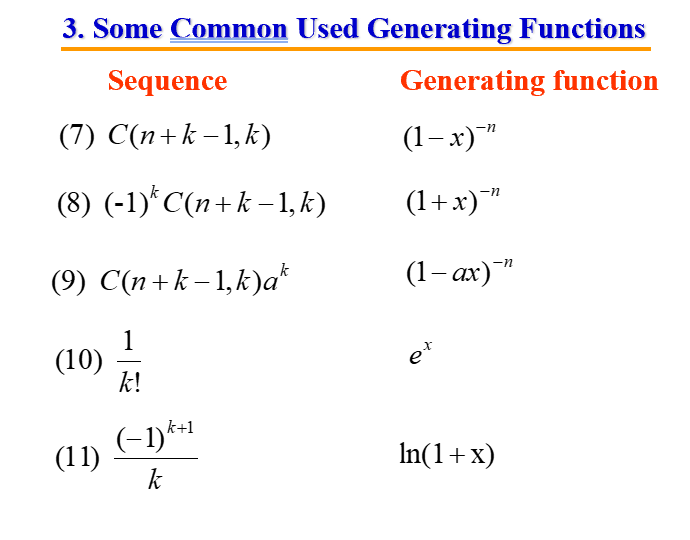
4 Counting with Generating Functions
【1】从n个元素里选r个,允许重复,有多少种可能
根据之前学的知识,这属于可重复的组合问题,比如A元素可以被选1次,或2次…
看成n个盒子,一共放r个球,如果A盒子放了3个球,意味着被选3次
n-1个bar,r个star
故答案为$C(n-1+r, r)$
我们使用生成函数来做这道题,一个元素可以被选0次,1次……
对应着x的0次方,1次方……
$$G(x) = (1+x+x^2+…)^n = (\frac{1}{1-x})^n$$
n个元素,每个元素有它被选的次数(每个括号贡献的指数),一共选r个,每一种选择乘起来就是$x^r$,所以最后结果中$x^r$的系数就是答案
根据之前的常见数列的生成函数,答案是$C(n-1+r, r)$
不过,我对这个方法的可靠性有一定的怀疑,但说不出来,目前先接受,如果你看到这句话的话,说明我还没说服自己(
【2】请找出$e_1+e_2+e_3=17$的所有非负整数解的个数,其中$2\le e_1\le 5, 3\le e_2\le 6, 4\le e_3\le 7$
这是带限制的相同球放不同盒子问题,一般方法还是比较难做的,但用生成函数可以很好地解决
$$G(x) = (x^2+x^3+x^4+x^5)(x^3+x^4+x^5+x^6)(x^4+x^5+x^6+x^7)$$
这三个括号分别代表$e_1,e_2,e_3$
找出这个式子中$x^{17}$的系数就是答案
这个方法还是没有疑问的,与原问题直接对应
找系数就只能慢慢找了,所以其实这道题直接枚举应该也可以(
【3】Suppose that there are 2r red balls, 2r blue balls, and 2r white balls. How many ways to select 3r balls from these balls?
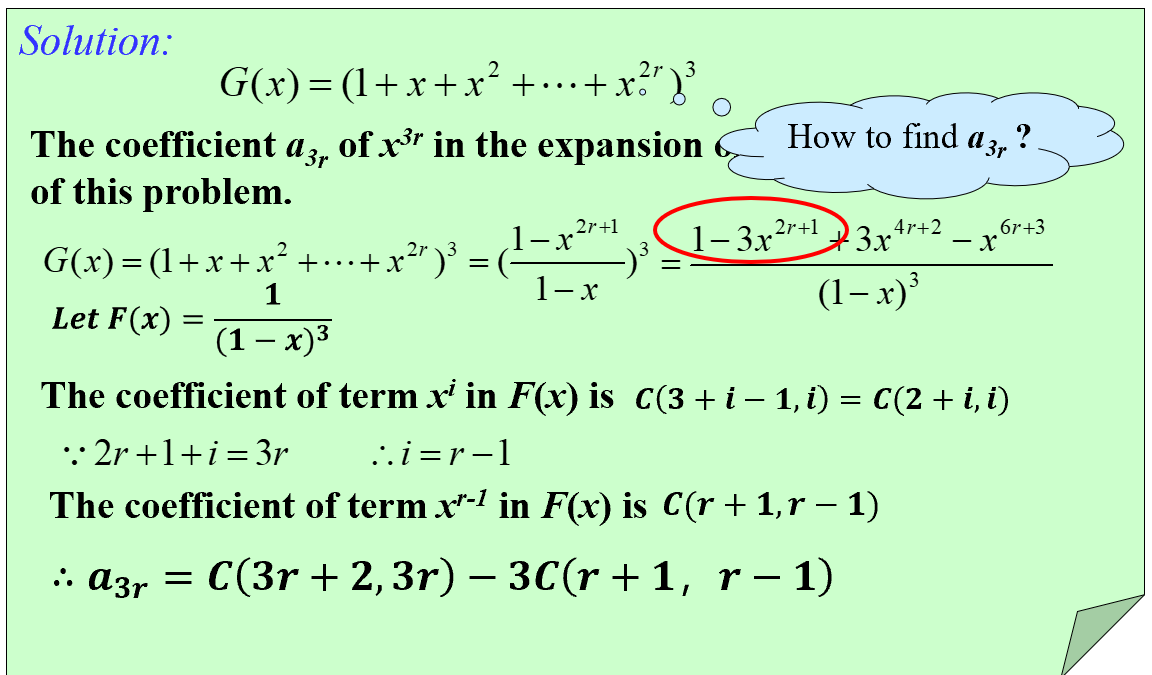
注意这里找$x^{3r}$系数的方法,其实如果是无穷项的话大概也是这个方法,只不过减$x^{2r+1}$会变成减去x的无穷大的次方,即之前【1】中应为$(\frac{1-x^\infty}{1-x})^n$,所以分子只用1就行,x的无穷大次方哪怕一次方也不用考虑了,这也许可以作为一个解释,当然还是要依赖于$(1-x)^{-n}$可以展开成无穷级数
【4】Determine the number of ways to insert tokens worth \$1,\$2 and \$5 into a vending machine to pay for an item that costs r dollars in both the cases when the order in which the tokens are inserted does not matter and when the order does matter.
先考虑次序不重要的情况,同样地,这道题也是1元、2元、5元可以被选多次,只不过要注意它们的数值
生成函数为$$G(x) = (1+x+x^2+…)(1+x^2+x^4+x^6+…)(1+x^5+x^{10}+x^{15}+…)$$找到$x^r$的系数即可
如果不使用生成函数,那么我们就按5元的个数分类讨论即可,例如r=10的情况,5元可以选0、1、2个,比如5元为1的情况,剩下5元又2元1元组成,2元可以选0、1、2个,就有三种。
如果考虑次序,那么每次我们可以选择1、2、5元,如果一共选了$n$个硬币,那么就是$(x+x^2+x^5)^n$
其中$x^r$的系数就是符合的情况,但是,我们又不知道一共会选多少个硬币,所以应该是下面这个式子中$x^r$的系数
$$G(x)=1+(x+x^2+x^5)+(x+x^2+x^5)^2+(x+x^2+x^5)^3+…=\frac{1}{1-x-x^2-x^5}$$
如果不用生成函数,这也是个不太简单的问题
假设有$f_r$种方法
如果最后选的是1元,那么前面有$f_{r-1}$种
2元,前面有$f_{r-2}$种
5元,前面有$f_{r-5}$种,得到递推式$$f_r=f_{r-1}+f_{r-2}+f_{r-5}$$
如果我们把$G(x)$看作$\sum f_kx^k$,$f_k$恰好代表r=k时的答案,右边分母乘过来
比较$x^n$系数,也可以得到相同的递推式
5 Using Generating Functions to Solve Recurrence Relations
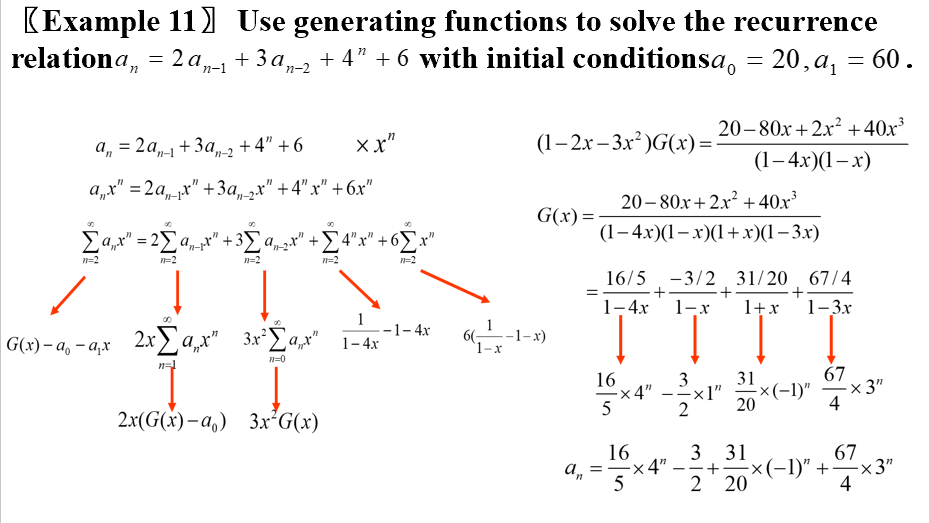
最后是靠$x^n$的系数对应$a_n$
6 Proving Identities via Generating Functions
例如证明$C(n,r) = C(n-1,r)+C(n-1,r-1)$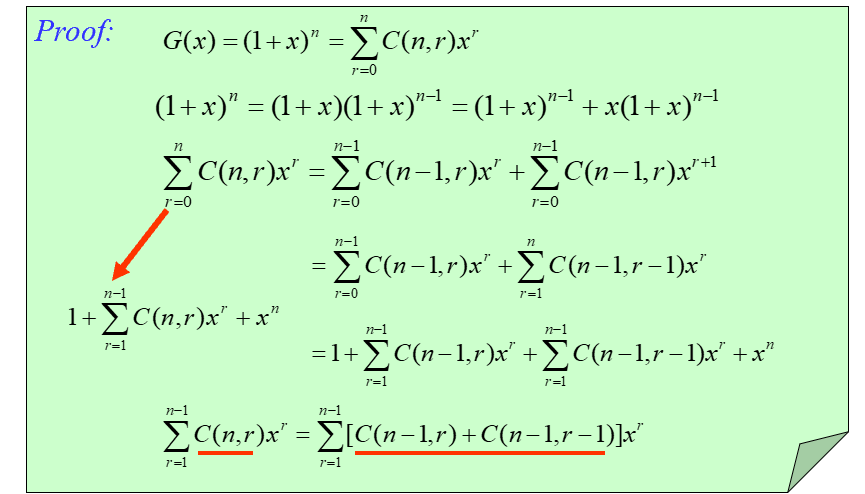
7 Inclusion-Exclusion
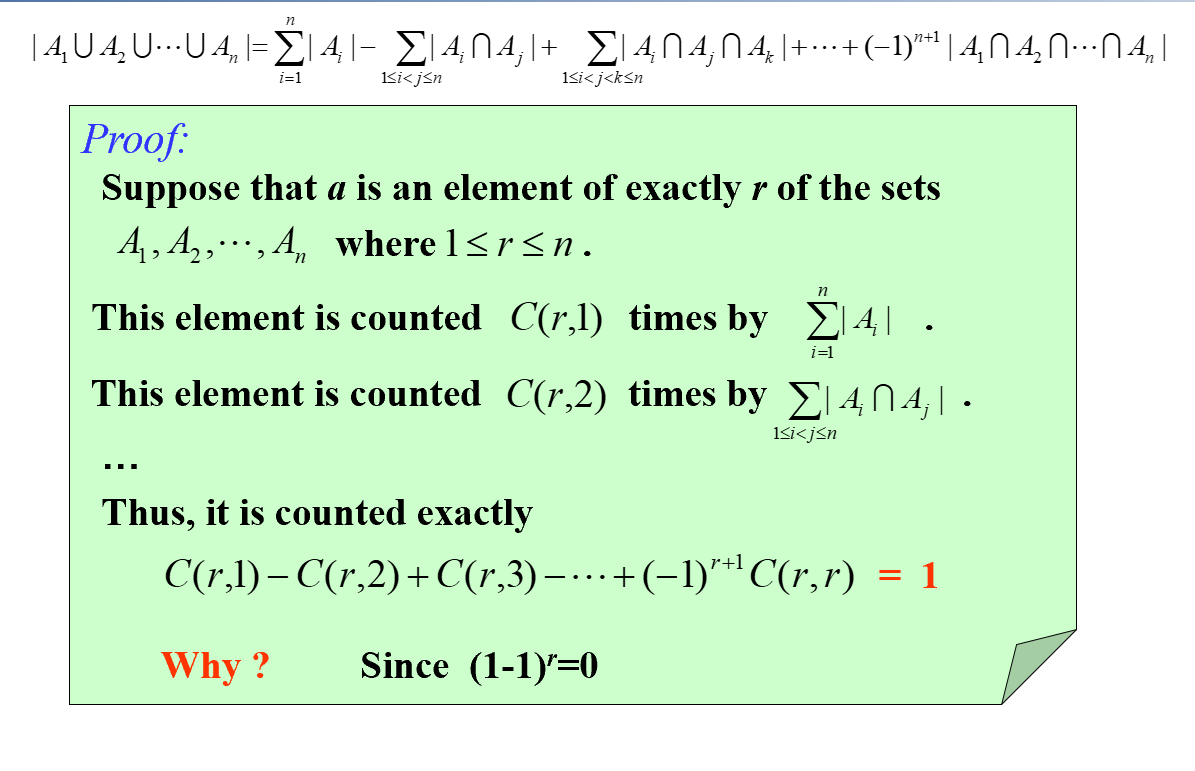
【1】不超过1000的正整数中,不被5、6、8整除的数有多少个
总数减去被5或6或8整除的数即可
被5或6或8整除的数等于
200+166+125-33-25-41+8=400
故答案为600
【2】26个字母的排列,不包含字符串fish、rat、bird的有多少
一共有26!种
包含fish的:把fish看作整体,然后全排列,有23!个
既包含fish又包含rat的,分别看作整体,21!个
而fish和bird不能同时出现,rat和bird不会同时出现(都有r),这三个也不会同时出现
所以答案为26!-(23!+24!+23!-21!-0-0+0)
8 Applications of Inclusion-Exclusion
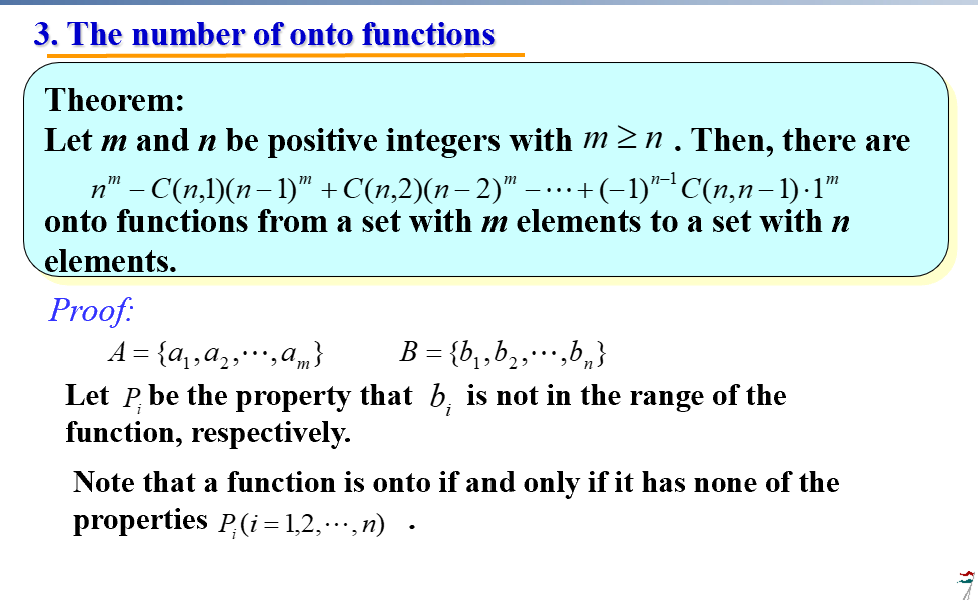
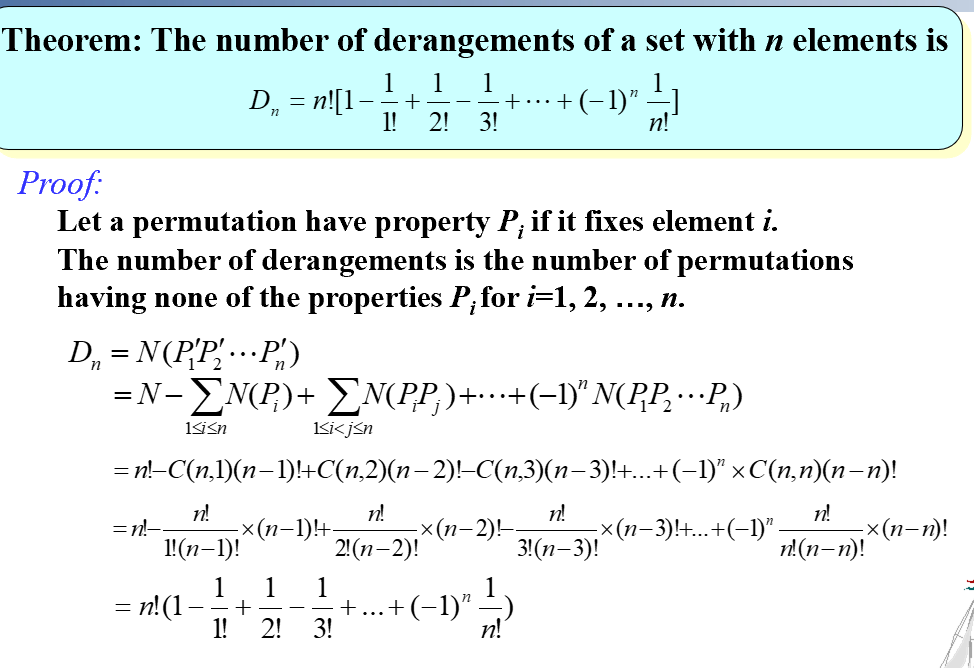
竟然漏了这一节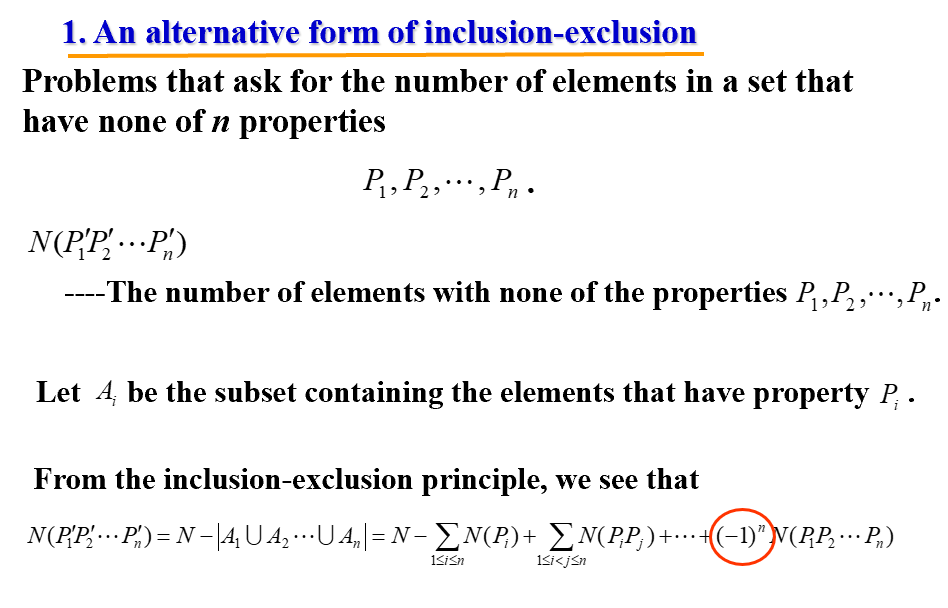
- Title: Chapter 8 - Advanced Counting Techniques
- Author: Hare Fuyukawa
- Created at : 2026-04-26 23:11:31
- Updated at : 2026-07-01 20:52:06
- Link: https://redefine.ohevan.com/Discrete-Mathematics/DM/DM-4/
- License: This work is licensed under CC BY-NC-SA 4.0.