
Chapter 3 - Combinational Logic Design

对不起,先鸽了,因为明天要考试了呜呜,要靠前辈的笔记先复习了
A combinational circuit consists of logic gates whose
output is a function of only the present input.
Sequential logic is a type of logic circuit whose output
depends not only on the present value of its input signals but on the sequence of past inputs (state or memory).
3 Arithmetic Functions
简单的方法,2N个输入,N+1输出的encoder,比如两位加两位,看作四输入,输出3位
但这意味着输入变量会非常多
我们采用Iterative combinational circuitis,我们的核心思想是设计出一个处理单比特运算的“基本单元 (Cell)”,然后把许多个这样的单元像链条一样串联起来,组成“迭代阵列 (Iterative array)”
- The functional blocks for arithmetic are referred
to as cells and the overall implementation is an
array of cells. - The iterative array is a method of calculating
decomposition and takes advantage of the
regularity to make a large and multiple-level
arithmetic circuit design feasible.
3.1 Half-Adder
两输入的一位加法器
| X | Y | S | C |
|---|---|---|---|
| 0 | 0 | 0 | 0 |
| 0 | 1 | 1 | 0 |
| 1 | 0 | 1 | 0 |
| 1 | 1 | 0 | 1 |
In essence, a half-adder is a 2-to-2 encoder.
S(sum bit)是和,C(carry bit)是进位
$$S=X\oplus Y,C=XY$$
当然S和C的表达方式有很多种,上面只是列举了最常见的一种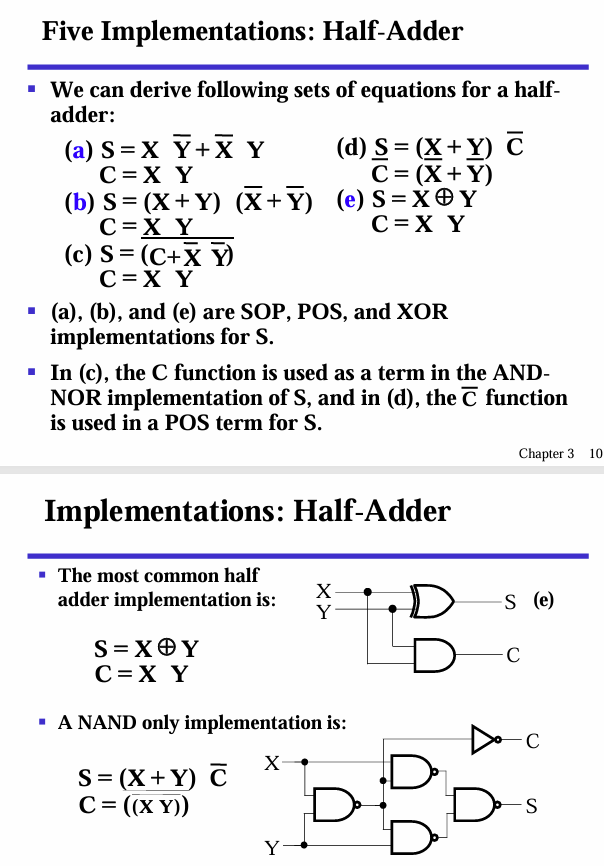
3.2 Full-Adder
A full adder is similar to a half adder, but includes a carry
in bit from lower stages. Like the half-adder, it computes a sum bit S, and a carry bit C.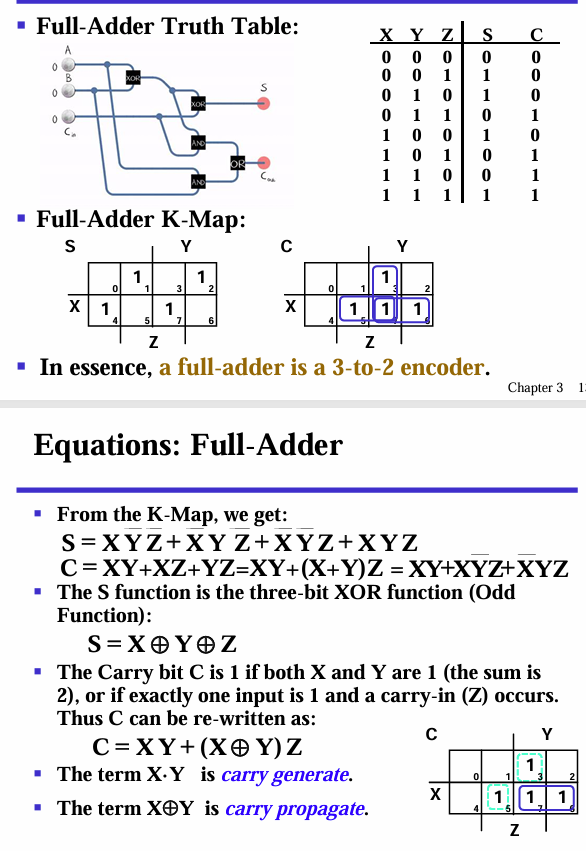
- Title: Chapter 3 - Combinational Logic Design
- Author: Hare Fuyukawa
- Created at : 2026-04-22 17:49:45
- Updated at : 2026-07-01 20:52:06
- Link: https://redefine.ohevan.com/Logic-and-Computer-Design-Fundamentals/LCDF/LCDF-chapter3/
- License: This work is licensed under CC BY-NC-SA 4.0.