
Chapter 4 - Sequential Circuits

1 Sequential Circuit Definition
A circuit whose output depends not only on the present input but also on the history of the input is
called a sequential circuit.
Figure 4-1(a) is block diagram of a sequential circuit, formed by interconnecting a combinational circuit and storage elements. The storage elements are circuits that are capable of storing binary information. The binary information stored in these elements at any given time defines the state of the sequential circuit at that time. The sequential circuit receives binary information from its environment via the inputs. These inputs, together with the present state of the storage elements, determine the binary value of the outputs.
The block diagram demonstrates that the outputs in a sequential circuit are a function not only of the inputs, but also of the present state of the storage elements. The next state of the storage elements is also a function of the inputs and the present state. Thus, a sequential circuit is specified by a time sequence of inputs, internal states, and outputs.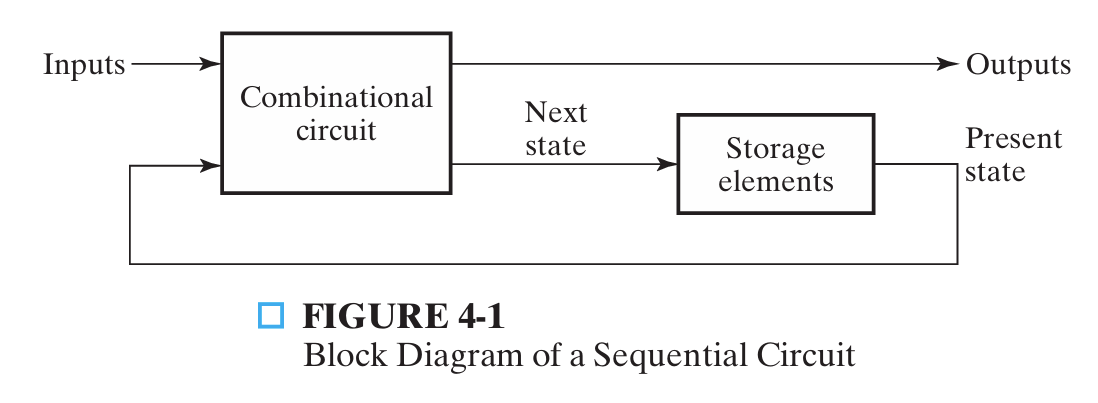
There are two main types of sequential circuits, and their classification depends on the times at which their inputs are observed and their internal state changes.
| 类型 | 核心定义 | 行为特征 |
|---|---|---|
| 同步时序电路(Synchronous) | 所有存储元件的时钟输入端连接到同一个全局时钟信号,状态更新严格同步发生在时钟的有效沿 | 行为由离散时间点的信号值定义,只有时钟脉冲到来时才会改变状态 |
| 异步时序电路(Asynchronous) | 没有统一的全局时钟,各个存储元件的时钟由前级电路的输出提供 | 行为由任意时刻的输入值和输入变化的顺序定义,状态逐个依次更新 |
同步时序电路的同步是通过时钟发生器(clock generator)这种时序器件产生周期性的时钟脉冲(clock pulse)序列来实现的。
同步存储元件只在每一个脉冲特定的时刻上受到影响
2 Latches
2.1 SR Latches
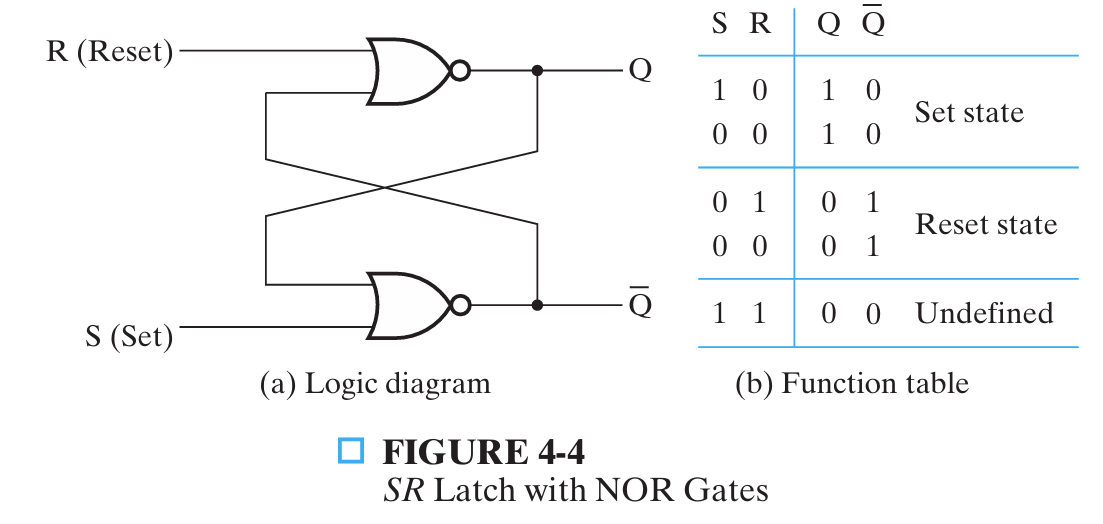
对于这个锁存器,我们来分析,
当S=R=0时,这时可以写出Q=Q,Q’=Q’,说明原先Q,Q’是什么,现在还是什么,不会变化
当S=1,R=0时,Q’一定是0,这时再看上面的或非门,0和0或非得到1,Q为1,此时Q和S异或得到0,我们说这个状态是稳定的
这时再把S=R=0,会发现Q=1,Q’=0,我们“记住”了这个结果
同理,把R=1,S=0,Q=0,Q’=1,接着把R设置回0,保存这个结果
不能做的是把S=R=1后又把S=R=0,因为S=R=1时,Q=Q’=0,这时又把S=R=0,Q和Q’都要变成1,这取决于谁先变成1,如果Q先变成1,Q’=0,反过来一样,所以我们无法确定Q和Q’是什么
使用与非门是同理的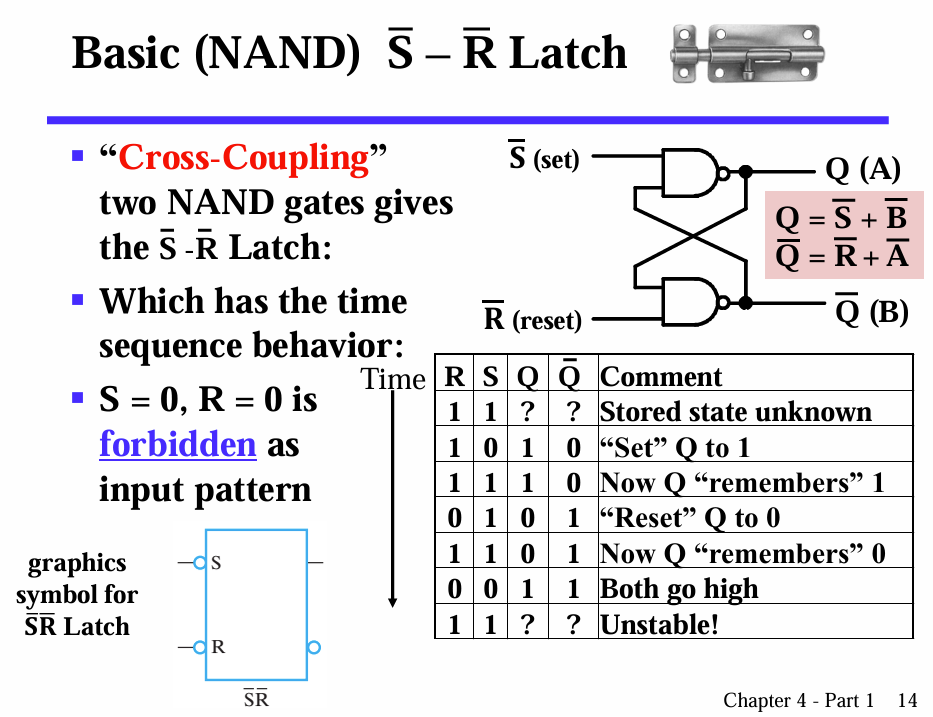
对于S’R’锁存器,同样地,如果先把S’=R’=0,那么Q和Q’就会先都是1,接着把S’=R’=1,如果门的延迟相同的话,Q和Q’然后同时变为0,又同时变为1……
这属于Unstable Latch Behaviors中的oscillation(振荡)
另一个不稳定行为是亚稳态,可以按下图理解,后面还会提及,Once you change an input, do not change it again until the circuit has had time to complete all its signal transitions and reach a stable state.
This is necessary to avoid the metastable behavior.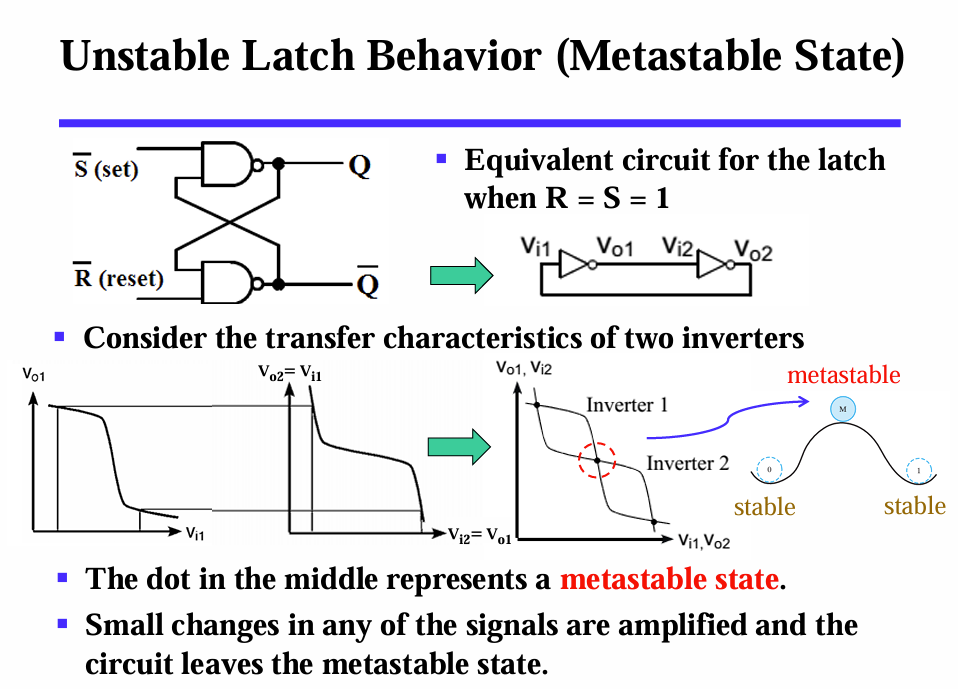
我们可以加上一个额外的输入控制信号,如果这个信号跟时钟脉冲序列有关,电路就变成同步的了,状态更新开始受时间控制,我们称之为SR触发器,虽然它并不是触发器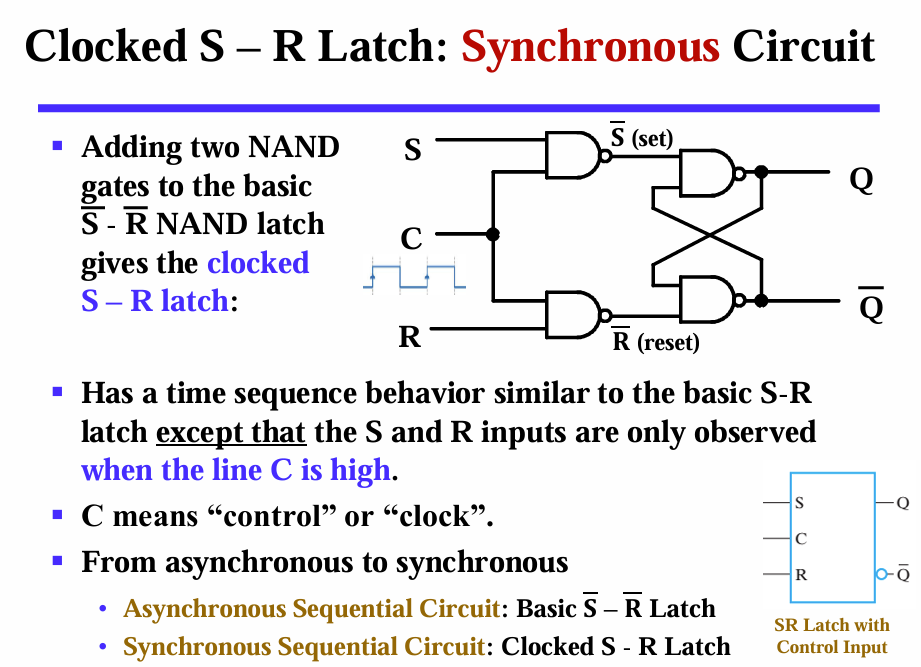
2.2 D Latches
既然不能出现S=R=1到S=R=0的情况,那么我们让S和R一定不一样就好了,但是要注意这也就不能“记住”一个状态了,因此我们使用D锁存器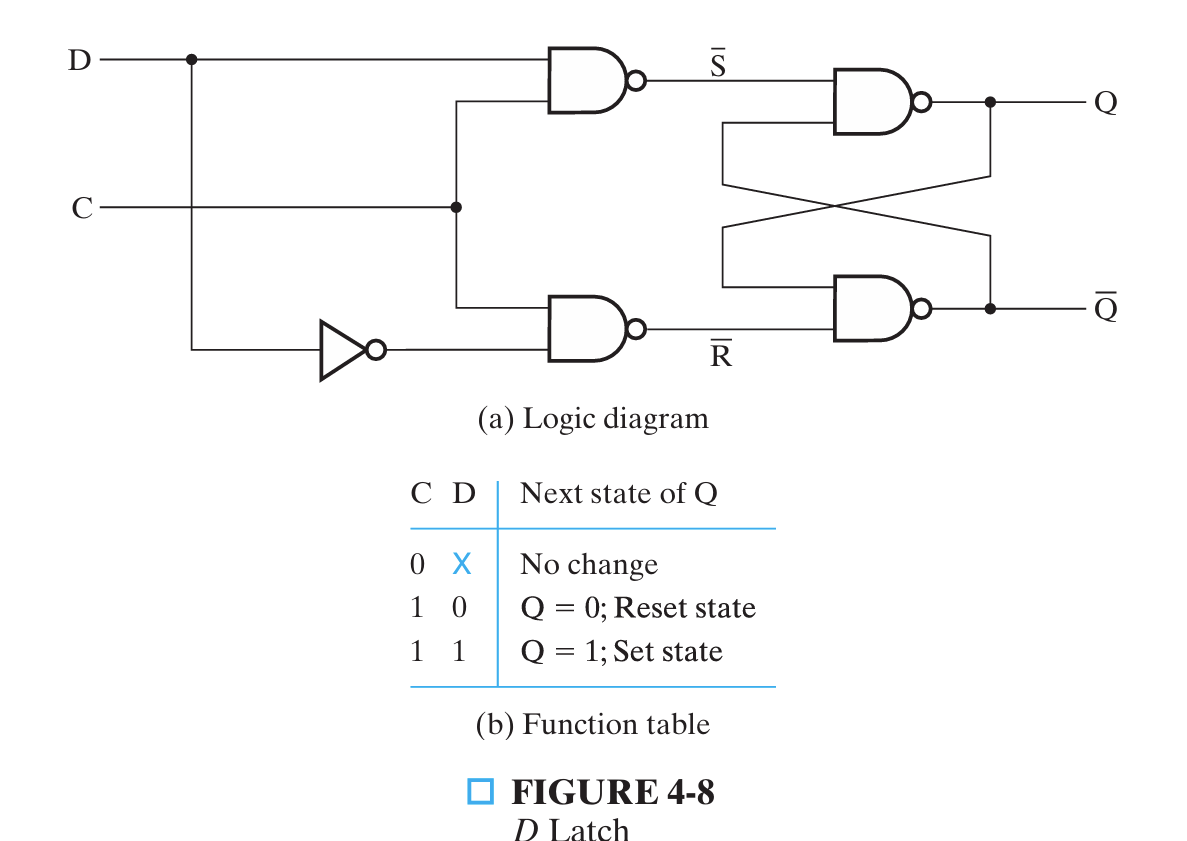
当控制信号为1时,Q的结果和D一样,而且Q和Q’的值一定相反,当控制信号为0时,无论D取什么,Q都不会变,即电路状态被记住,不会改变(其实就是S=R=0的情况),数据输入端在C从1变到0时的信息会一直保持在输出端Q不变,直到C再次变为1
3 Flip-Flops
As long as the pulse remains at the active (1) level,any changes in the data input will change the state of the latch. In this sense, the latch is transparent, since its input value can be seen from the outputs while the control input is 1.
例如我们把D锁存器的Q’接到D,那么只要C=1,假设初始Q为1,那么Q就会在0和1间反复横跳,最终状态取决于C=1的时长,这是我们不希望看到的
解决方法就是,在输出信号改变前,让输入信号与输出信号间的通路断开
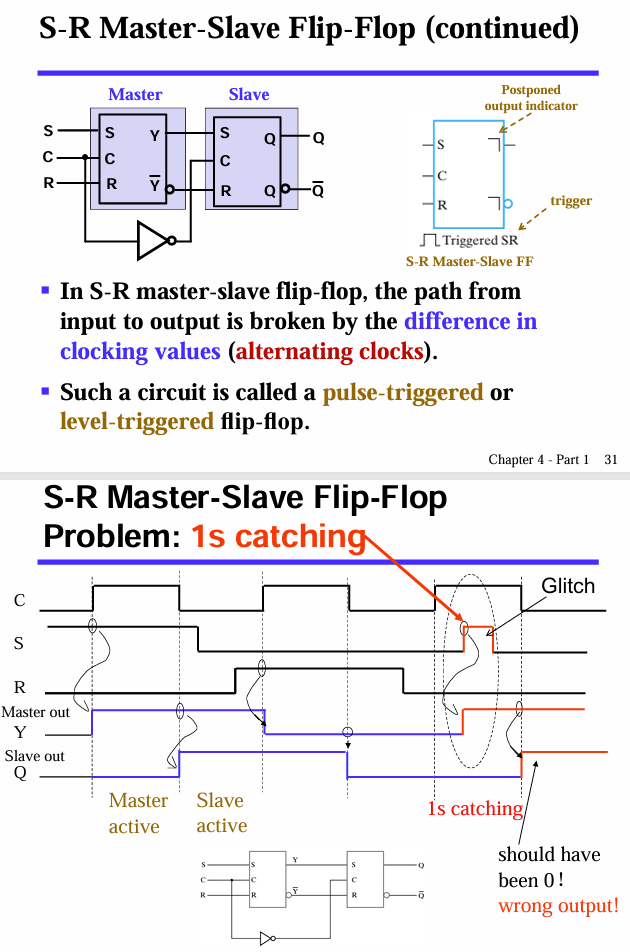
SR主从触发器,当C为1时,左边的锁存器(主锁存器)工作,右边的保持不变,当C变为0时,左边锁存器的结果作为右边锁存器的输入,右边锁存器输出左边锁存器在C=1时最后的结果,哪怕将Q’接到S,C=1时Y和Y’会一直跳,但Q保持不变
但是如果在C=1时,有一个glitch,S从0到1又变到0,那么主锁存器会记住S=1时Y=1的结果,这下C=0后Q就是1了,但本来没有glitch应该输出Q=0的,这就是1s catching问题
边沿式触发器(edge-triggered flip-flop)可以解决这种问题,它只在时钟转变的时候触发
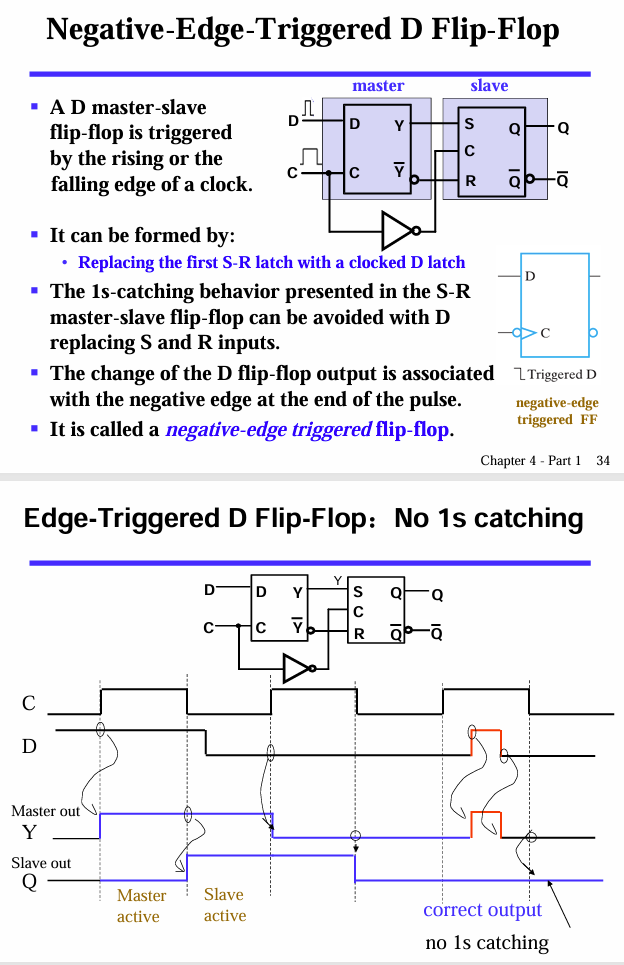
负边沿D触发器,当C=1时,Q保持不变,D是什么,Y就是什么,当C从C=1变到C=0时,第二个锁存器工作,Q=Y=D输出出来
当C=1时,D从0到1再到0是没问题的,因为Y相应地也会从0到1再到0,这就避免了1s catching问题
正边沿D触发器只需在C后面加一个非门即可
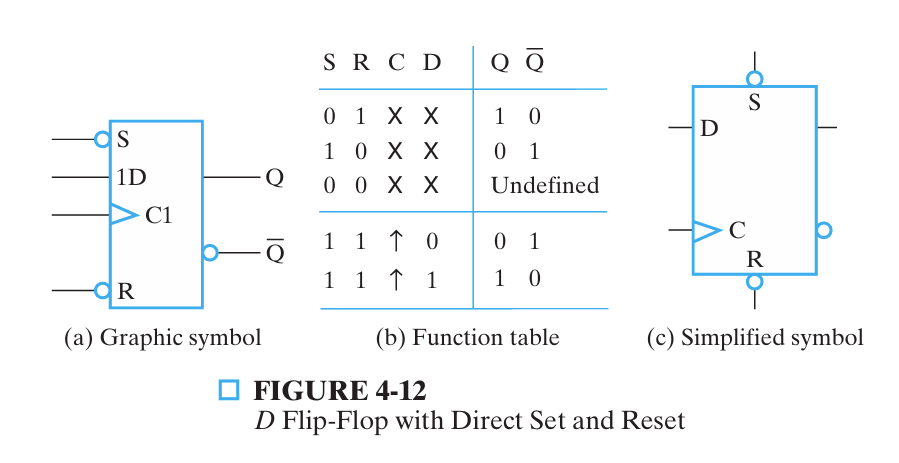
3.1 Direct Inputs
- At power up or at reset, all or part of a sequential circuit usually is initialized to a known state before it begins operation
- This initialization is often done outside of the clocked behavior of the circuit, i.e., asynchronously.
- Direct R and/or S inputs that control the state of the latches within the flip-flops are used for this initialization.

3.2 Symbols
第二行描述部分的符号,指正脉冲和负脉冲
第三行描述部分的符号指正边沿和负边沿
第三行C前的箭头表示C是动态输入,动态指示符号表示触发器在时钟脉冲的边沿跳变时才会响应
第二行的延时输出指示器符号表明输出信号在脉冲结尾才变化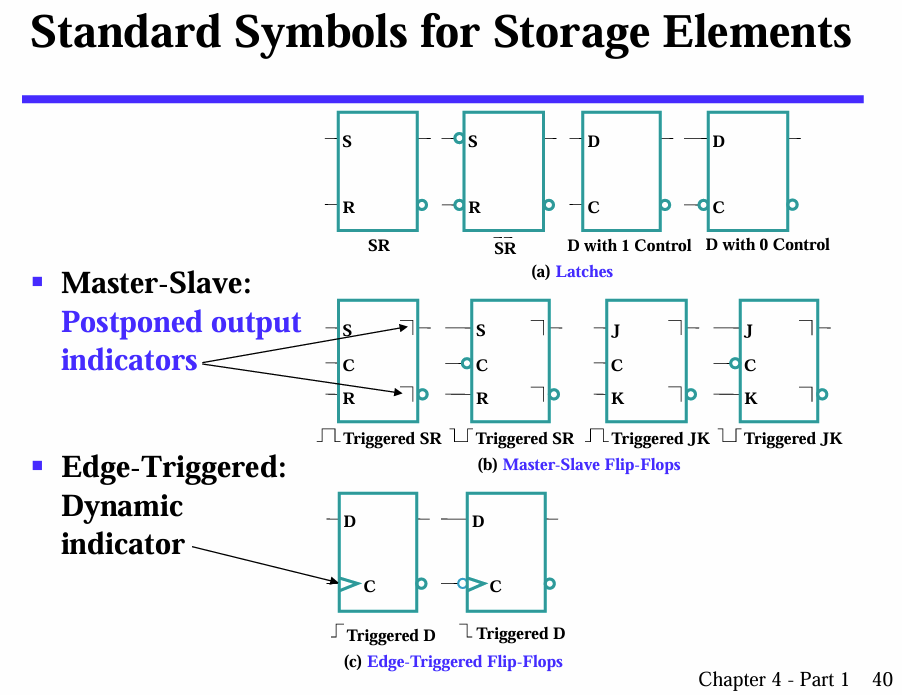
4 Flip-Flop Timing
For both flip- flops, there is a minimum time called
the setup time, $t_s$, for which the S and R or D inputs must be maintained at a constant value prior to the occurrence of the clock transition that causes the output to change. This is so that the data can be stored successfully in the flip-flop.
Otherwise, the master could be changed erroneously in the case of the master – slave flip - flop or be at an intermediate(不确定的) value at the time the slave copies it in the case of the edge-triggered flip-flop.
Similarly, there is a minimum time called the hold time, $t_h$, for which the S and R or D inputs must not change after the application of the clock transition that causes the output to change so that data is reliably sampled by the clock. Otherwise, the master might respond to the input change and be changing at the time the slave latch copies it
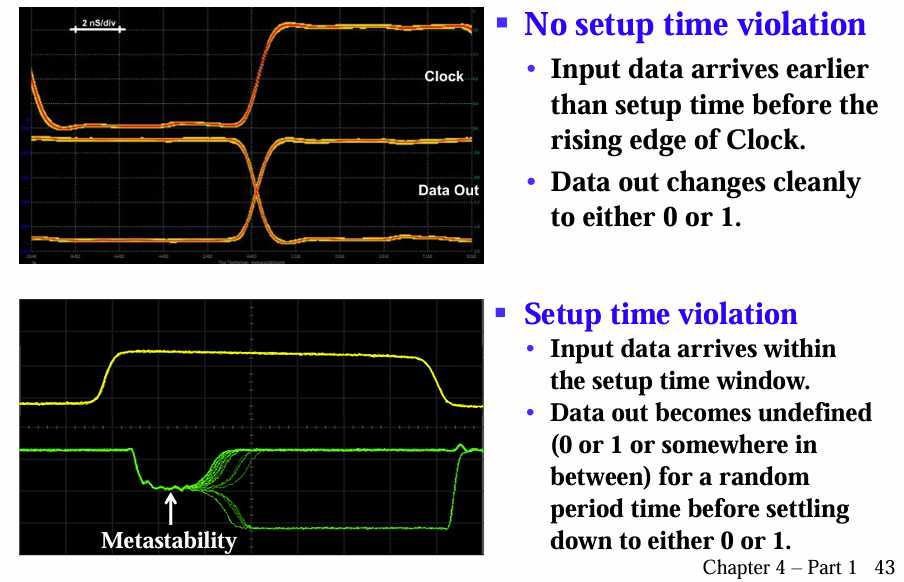
When a flip-flop samples an input that is changing during its aperture(也叫setup hold window,就是ts+th这段时间),the output Q may momentarily take on a voltage between 0 and VDD, that is in the forbidden zone. This is called a metastable state.
4.1 Flip-Flop Timing Parameters
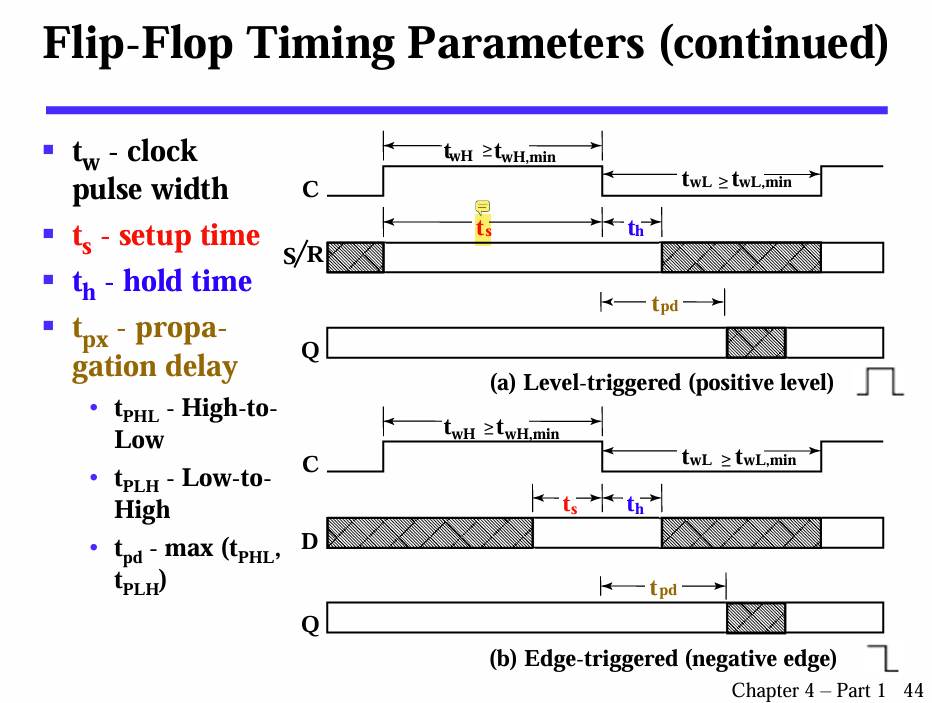
注意脉冲式触发器的set up time等于clock pulse width,因为这一段都必须保持稳定,这是为了避免1s catching问题,正如上面分析的,如果S变成1,哪怕立刻变回0(假设我们希望的输入是S=R=0),Y也会保持1,这时如果你仅保持C从1变到0前的一小段时间输入稳定,比如S=R=0,是错的
但D边沿触发器不一样,只要你在C从1变到0之前一小段时间保持D=1,结果就是1
此外要注意,ff的传播时间一般都长于且覆盖保持时间,一般认为$t_h=0$,注意传播时间$t_{px}$是从时钟触发边沿到输出改变的时间
4.2 Timing Analysis of Sequential Circuits
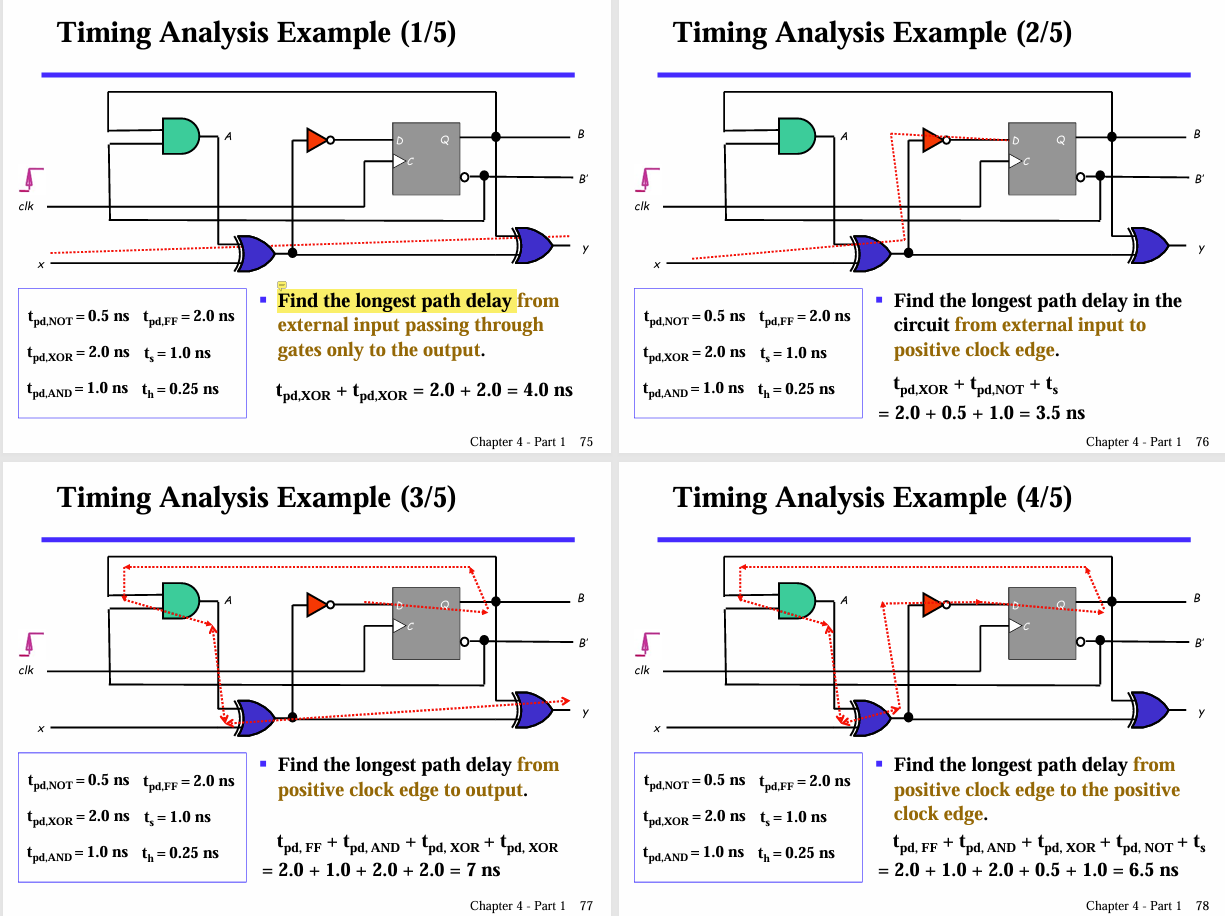
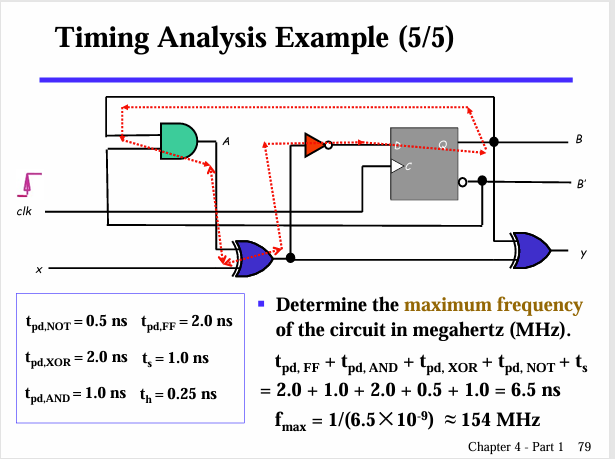
关键是确认最大时钟频率,时钟频率等于时钟周期的倒数
时钟周期指两个触发边沿之间的时间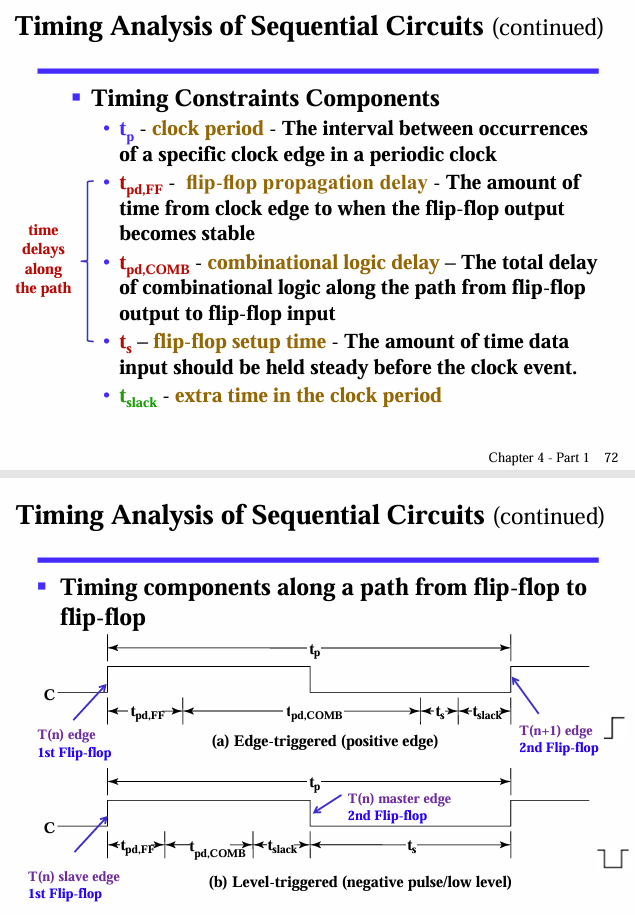
5 Sequential Circuit Analysis
- Identify the inputs, outputs, and internal states
- Determine the output equations, inputs and outputs of
flip-flops (i.e., input equations and next state equations) - Derive the state table (truth table with state):
• Inputs: inputs of circuit, present state of the circuit
• Outputs: outputs of circuit, next state of all flip-fops - List the next state of the sequential circuit
- Obtain a state diagram
- Analyze the performance of the circuit
- Verify the correctness of the circuit, check the self
recovery capability and draw the timing parameters
6 Other Flip-Flop Types
6.1 J-K Flip-Flop
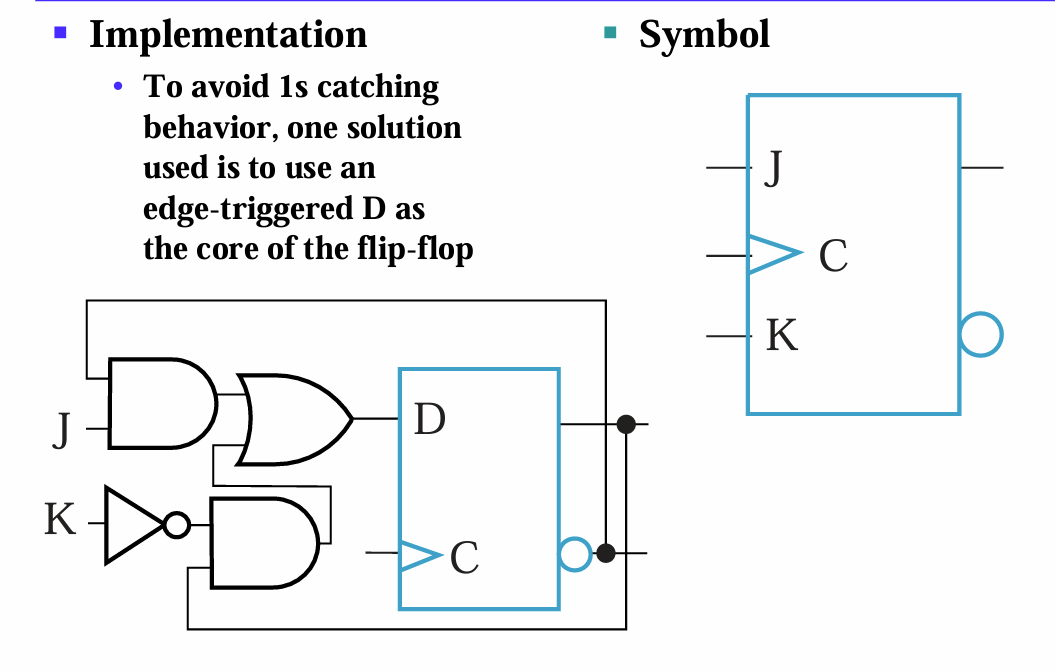
J=K=0,Q输入给D,保持不变
J=K=1,Q’输入给D,结果取反
J=0,K=1,使Q置为0
J=1,K=0,使Q置为1
6.2 T(Toggle) Flip-Flop
令J=K=T,这样,T=0时保持,T=1时状态取反
T触发器不能被初始化到一个已知的状态,因此,需要一个reset信号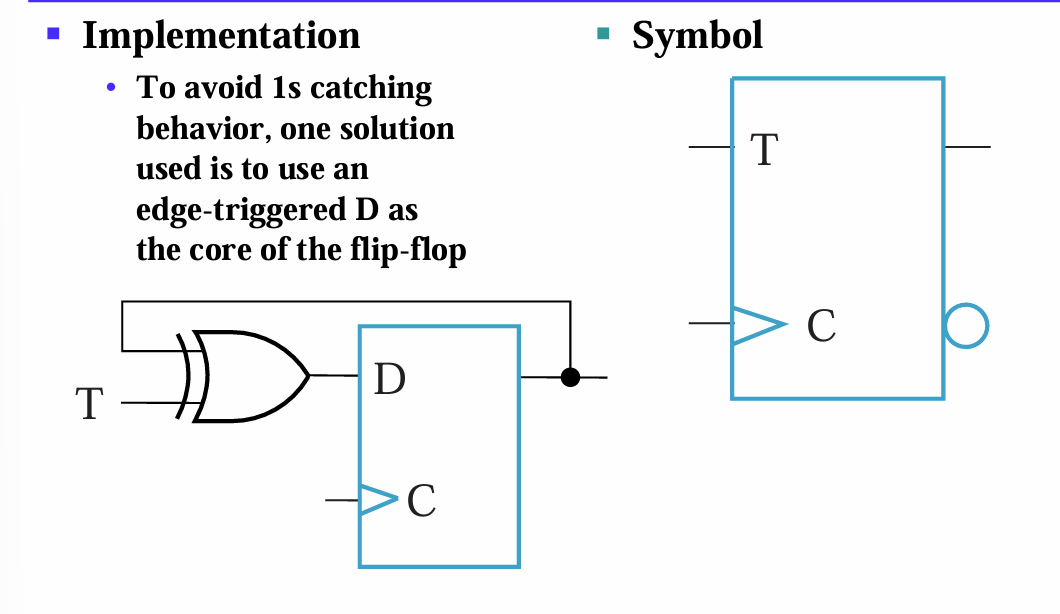
7 Sequential Circuit Design
7.1 Sequence Recognizer Example
我们现在想设计一个能识别序列1101的数字系统
例如输入11001101
输出为00000001
也就是对于t时刻,如果x(t-3,t)=1101,那么z(t)=1,否则为0
时序电路设计的过程时先得到状态图,进一步得到状态表、激励表(类似$D_A=A(t+1)$)从而得到输入方程、输出方程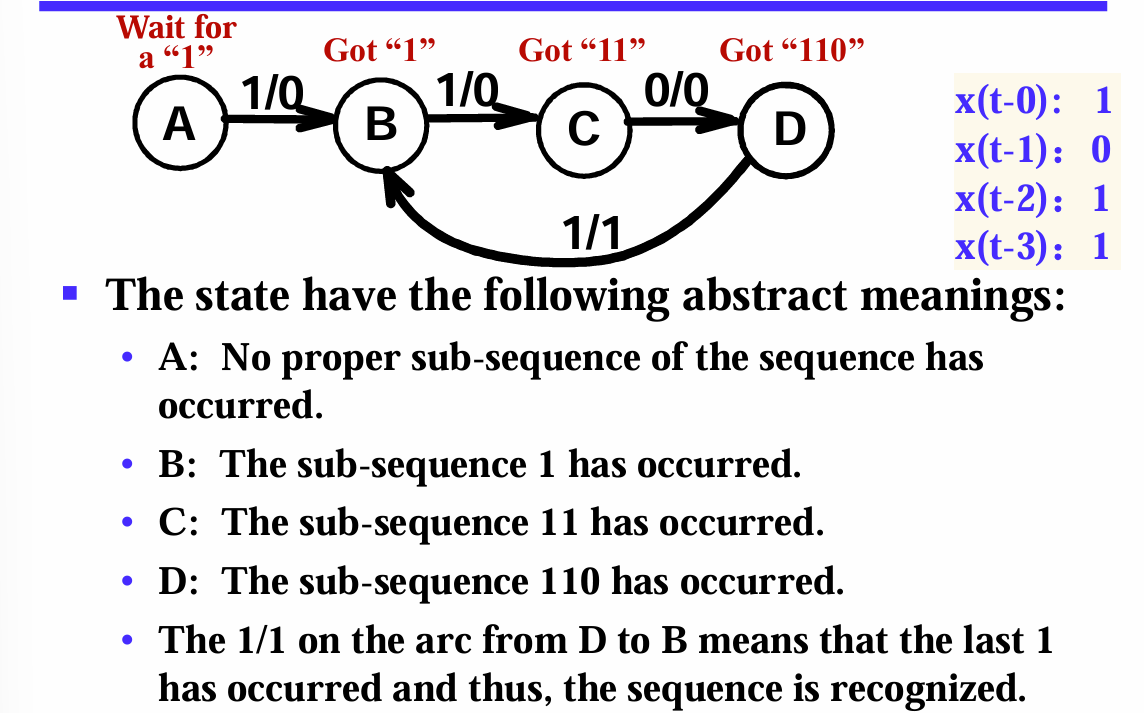
我们就从正确序列1101开始设计,假定A是个初始状态,也就是刚开始识别接下来的4个数字,如果输入是1,那么输出0,来到B状态,如果B状态接受的输入为1,那么输出0,来到C状态,如果C接受0,输出0,来到D,如果D接受输入1,那么输出1(已识别1101),回到哪个状态呢?
这时相当于重新开始识别,但要注意,D状态接受的1完全可以作为下一个1101的开始,例如输入为1101101,所以到B状态
接下来补充其他情况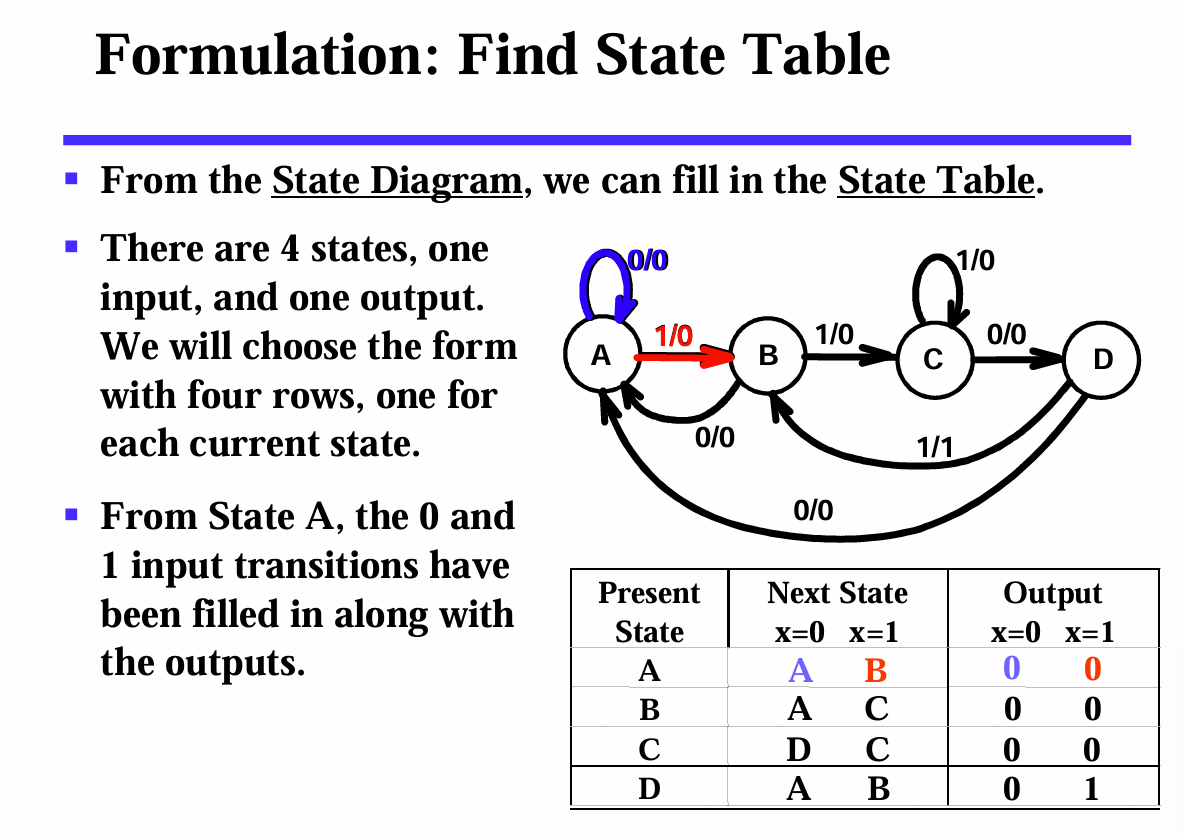
输出取决于状态和输入,属于Mealy型,我们也可以改变成Moore型
从上图改起,注意到状态A总是输出0,B总是输出0,C总是输出0
但是D有些特殊,输出并不只取决于状态
所以我们需要一个新的状态E,它和D很像,这个状态下会输出1,也就是D得到1转变到E状态,和原来一样,D得到0回到A状态,但这时问题在于,原来D得到1会输出1的同时回到B,现在它只是转到E状态,接下来怎么办呢
假设我们已经得到了1101,接下来如果是1,接着开始记,这时已经记了11了,所以到B状态,如果接下来是0,即11010,那么废了,重新开始,回到A状态
这与米勒型不同,米勒型输入和状态决定输出,所以D后如果输入为1,直接输出1,且此时已经开始下一次记录了(第一个1),所以到B,D后如果输入为0,废了并且从头开始,输出0回到A
但摩尔型就不能这样,因为新增一个专门输出1的状态E,如果D得到输入1,会进入E状态,这时其实E就是B的状态,如果下一个是1,继续,到C,如果是0,从头开始,到A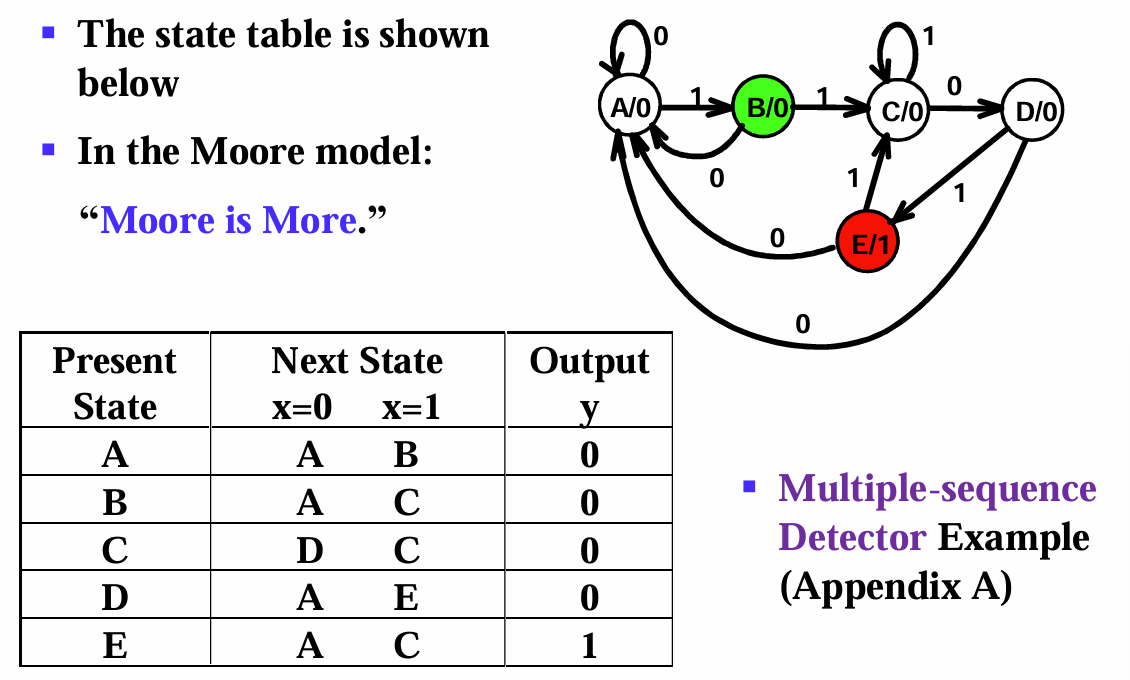
Equivalent States: Assume S1 and S2 are two states in the complete state table, and begin with S1 and S2, if we have exactly same output sequence and the same next states (or next states are interleaved/circulated) for any input sequence, S1 and S2 are called equivalent states, denoted (S1, S2).
等价的状态可以合并
State Assignment Method
我们要给每个状态编码,可以选格雷码,独热码等等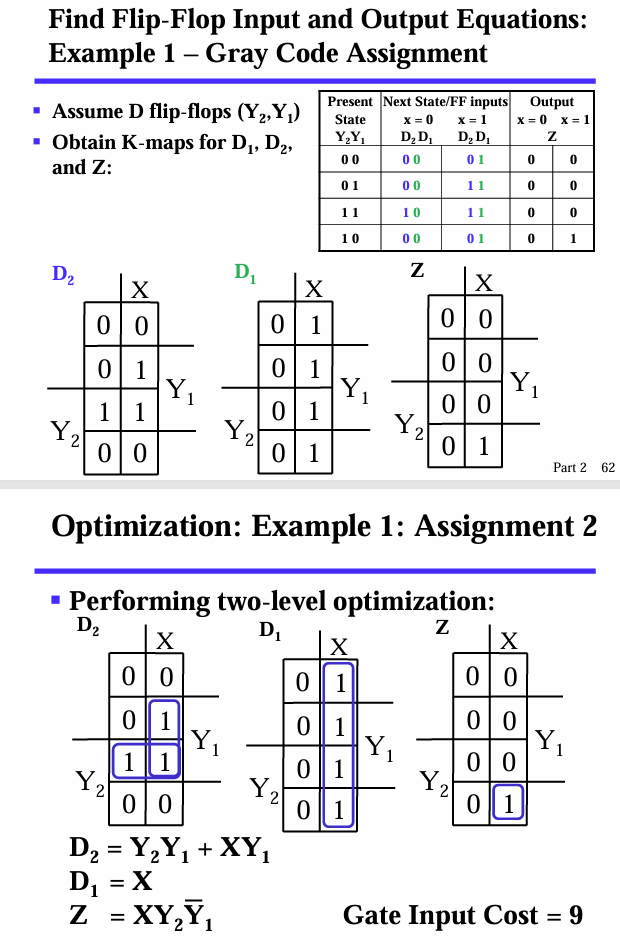
这里D的方程就是输入方程,Y的方程就是输出方程,实际上,这个问题中用格雷码门输入代价最小
最后使用Map Technology得到实际电路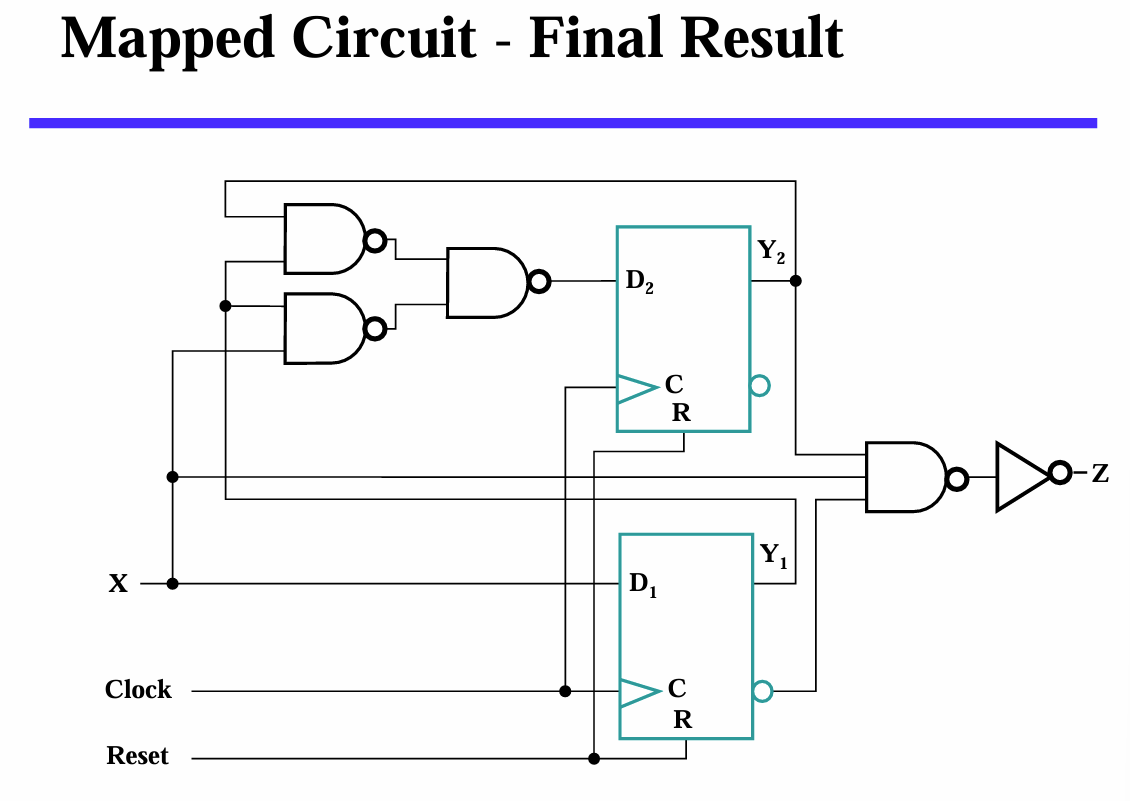
- Title: Chapter 4 - Sequential Circuits
- Author: Hare Fuyukawa
- Created at : 2026-05-17 11:32:55
- Updated at : 2026-07-01 20:52:06
- Link: https://redefine.ohevan.com/Logic-and-Computer-Design-Fundamentals/LCDF/LCDF-chapter4/
- License: This work is licensed under CC BY-NC-SA 4.0.