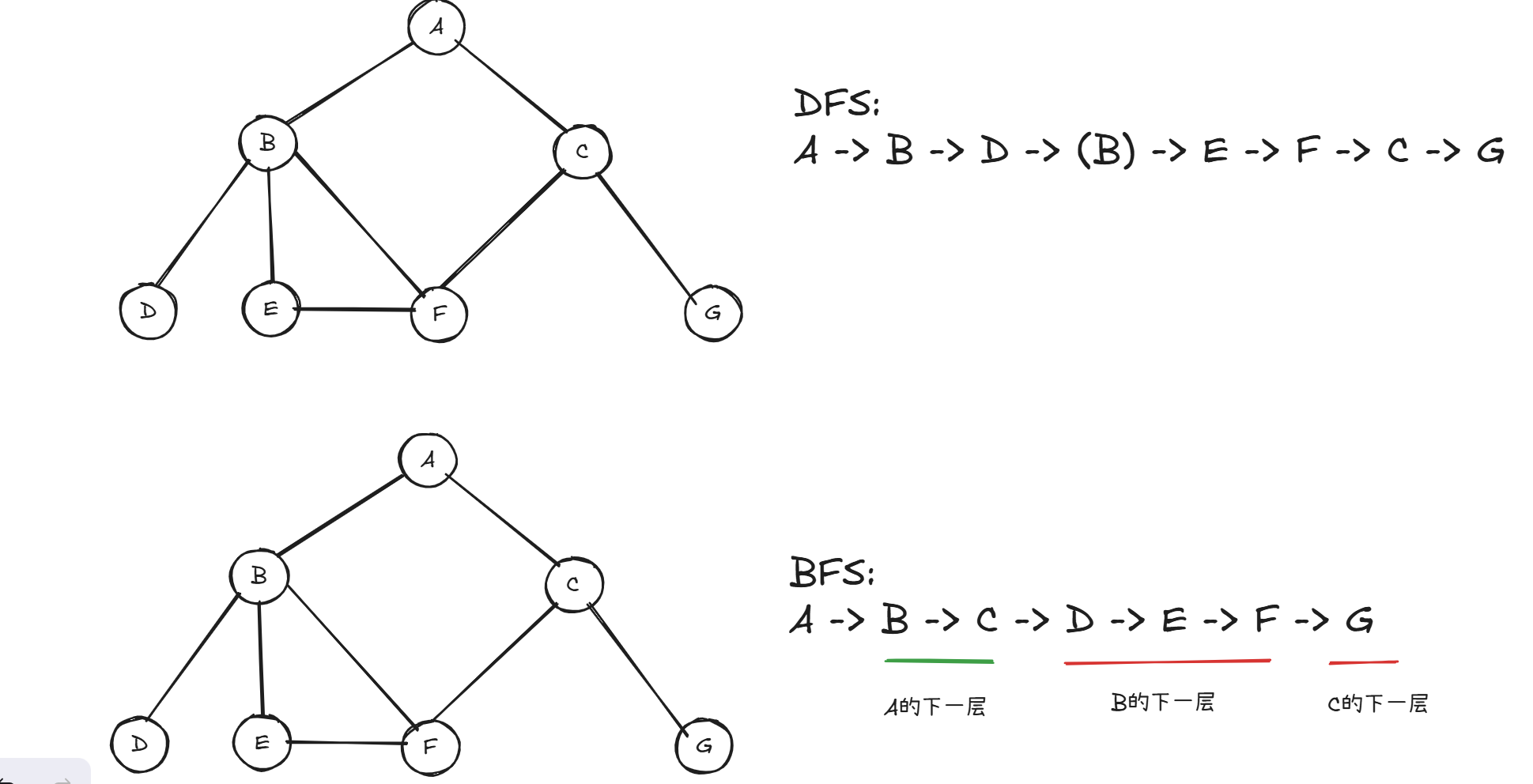
1 Depth-First Search and Breadth-First Search

1
2
3
4
5
6
7
8
9
10
11
12
13
14
15
16
17
18
19
20
21
22
23
24
25
26
27
28
29
30
31
32
33
34
35
36
37
38
39
40
41
42
43
44
45
46
47
48
49
50
51
52
53
54
55
56
57
58
59
60
61
62
63
64
65
66
67
68
69
70
71
72
73
74
75
76
77
78
79
80
81
82
83
84
85
86
87
88
| #include <stdio.h>
typedef char VertexType;
typedef int EdgeType;
#define MAXN 100
typedef struct {
VertexType vertex[MAXN];
EdgeType arc[MAXN][MAXN];
int vertex_num;
int edge_num;
}Graph;
int visited[MAXN];
void dfs(Graph* g, int i)
{
visited[i] = 1;
printf("%c ", g->vertex[i]);
for (int j = 0; j < g->vertex_num; ++j)
{
if (g->arc[i][j] == 1 && visited[j] == 0)
{
dfs(g, j);
}
}
return;
}
void bfs(Graph* g, int start)
{
int queue[MAXN] = { 0 };
int front = 0;
int rear = 0;
queue[rear++] = start;
visited[start] = 1;
printf("%c ", g->vertex[start]);
while (front != rear)
{
int u = queue[front++];
for (int j = 0; j < g->vertex_num; ++j)
{
if (g->arc[u][j] == 1 && visited[j] == 0)
{
visited[j] = 1;
printf("%c ", g->vertex[j]);
queue[rear++] = j;
}
}
}
}
int main()
{
Graph g;
g.edge_num = 9;
g.vertex_num = 9;
g.vertex[0] = 'A';
g.vertex[1] = 'B';
g.vertex[2] = 'C';
g.vertex[3] = 'D';
g.vertex[4] = 'E';
g.vertex[5] = 'F';
g.vertex[6] = 'G';
g.vertex[7] = 'h';
g.vertex[8] = 'i';
g.arc[0][1] = g.arc[1][0] = 1;
g.arc[0][2] = g.arc[2][0] = 1;
g.arc[1][3] = g.arc[3][1] = 1;
g.arc[1][4] = g.arc[4][1] = 1;
g.arc[4][5] = g.arc[5][4] = 1;
g.arc[2][5] = g.arc[5][2] = 1;
g.arc[1][5] = g.arc[5][1] = 1;
g.arc[2][6] = g.arc[6][2] = 1;
g.arc[7][8] = g.arc[8][7] = 1;
for (int i = 0; i < g.vertex_num; ++i)
{
if (visited[i] != 1)
{
dfs(&g, i);
printf("\n");
}
}
return 0;
}
|
使用邻接表,深度优先搜索和广度优先搜索的复杂度为$O(V+E)$,因为
2 Application
2.1 Biconnectivity
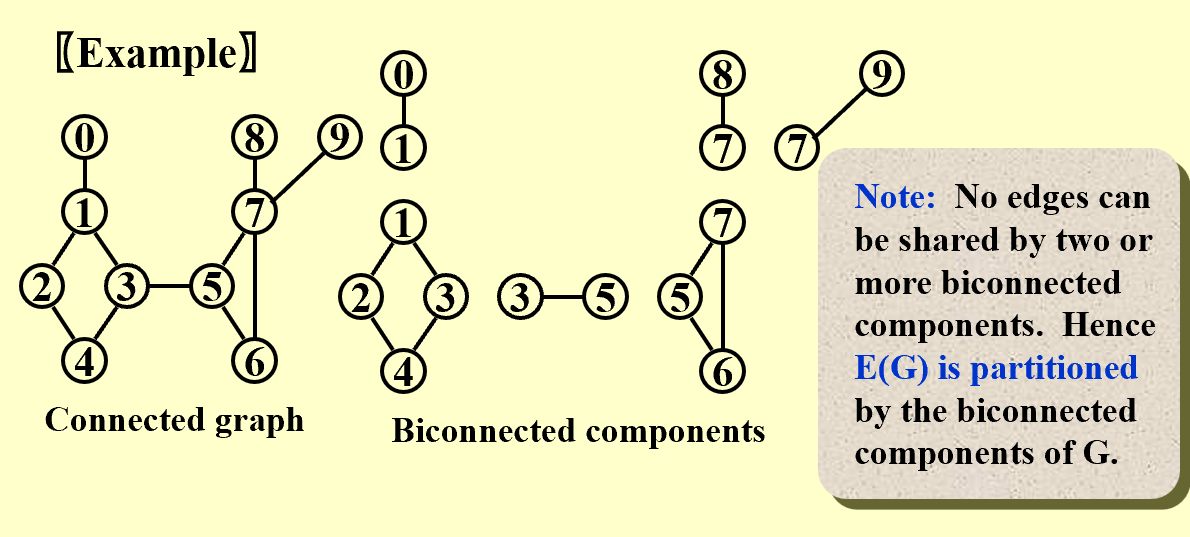
$v$ is an articulation point if G’ = DeleteVertex(G, v) has at least 2 connected components.
即删去割点,图会断开
$G$ is a biconnected graph if $G$ is connected and has no articulation points.
即无论删去哪个点,图依然连通
A biconnected component is a maximal biconnected subgraph.
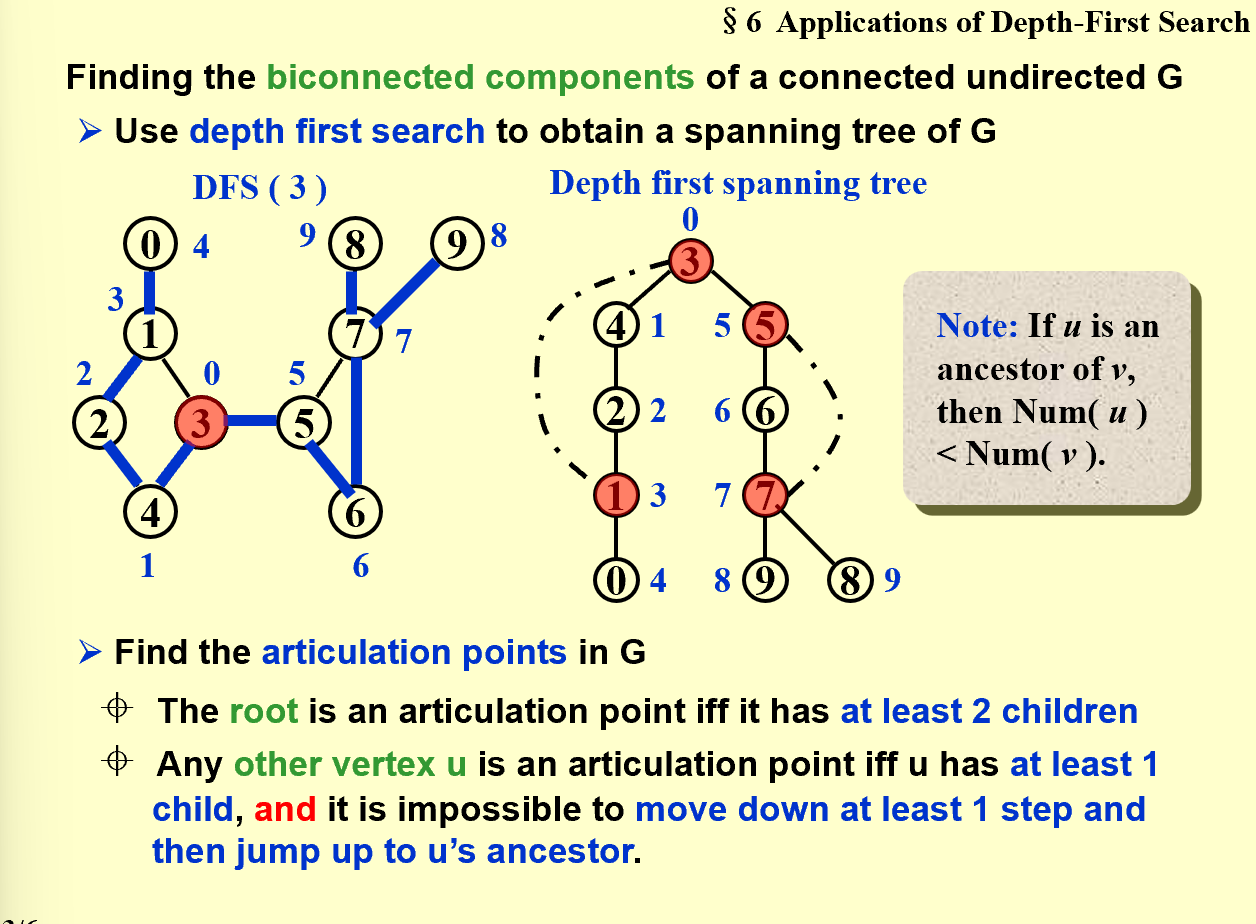
回边:Depth first spanning tree里没有的边,但在原图里有的边,比如1其实在原图是可以到3的,只是这个边没被遍历到而已
另外spanning tree跟从谁开始dfs无关
根如果有至少两个孩子肯定是割点,因为光是在树中,删了根就已经分割成至少两部分了,反过来,如果是割点,一定有至少两个孩子,否则就是一条链,那去掉根仍连通
对于其他点,割点的判断标准是至少有一个孩子,而且至少往下走一步后,不能跳回它的ancestor,也就是Num比它小的点
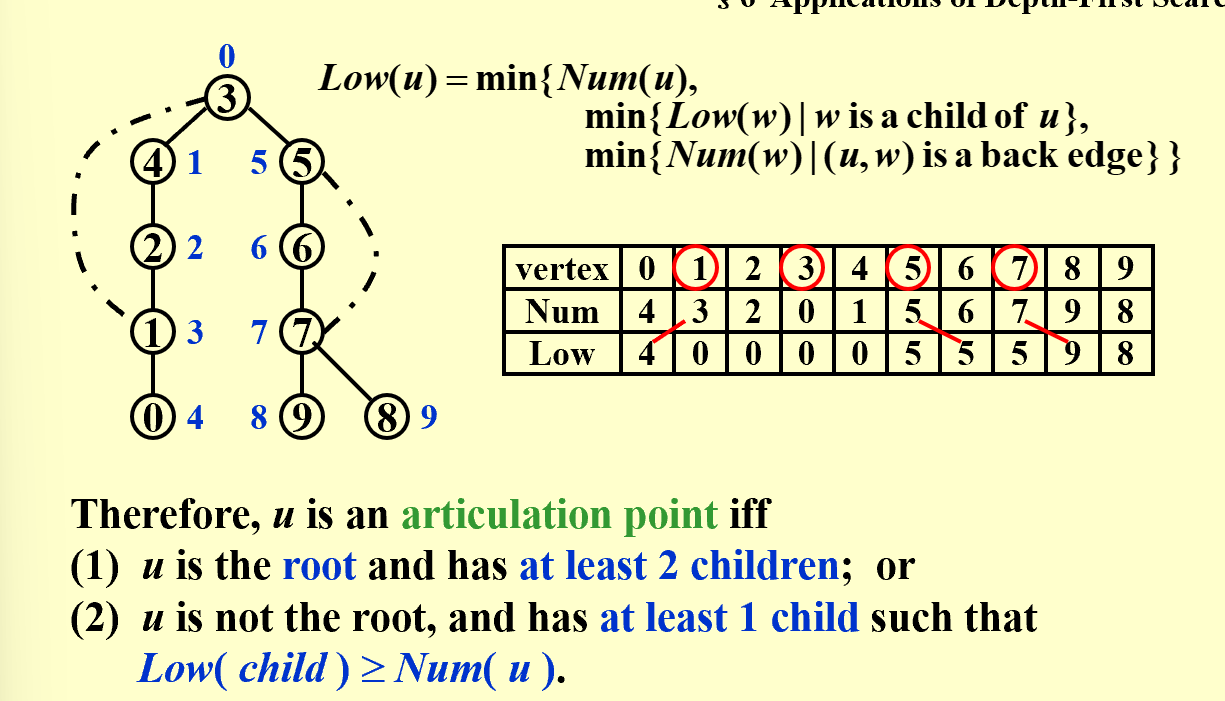
例如5往下走多少步都回不到3了,但是6往下走一步可以回到5,9没孩子不是割点,4往下两步可以回到3
用程序语言来说,如果u不是根,且至少有一个孩子,而且$Low(child)\ge Num(u)$,注意Low(u)的定义实际上就是从u或u的孩子出发向下,最多允许跳一次回边向上,能到达的Num最小的值,所以对于5来说,它的孩子,6的Low为5,意味着5往下走多少步都回不到3了,最多回到5,回到的Num大于等于Num(5),这跟上面的“不能跳回Num比它小的点”相符
所以为什么至少有一个孩子,不能跳回Num比它小的点就是割点了呢,因为它的孩子比如A,最多只能回到这个点u,如果删去u,A就回不到在u上面的点了(u不是根,上面肯定有点),所以图就断开了
2.2 Euler Circuits
Euler tour: 一笔画遍历每条边
Euler circuit: 一笔画遍历每条边,而且起点和终点要相同
如果存在欧拉回路,那么这个图连通,而且每个顶点的度是偶数
如果恰好有两个顶点的度为奇数,那么欧拉路径(tour)存在,且这两个点中有一个为这条路径的起点
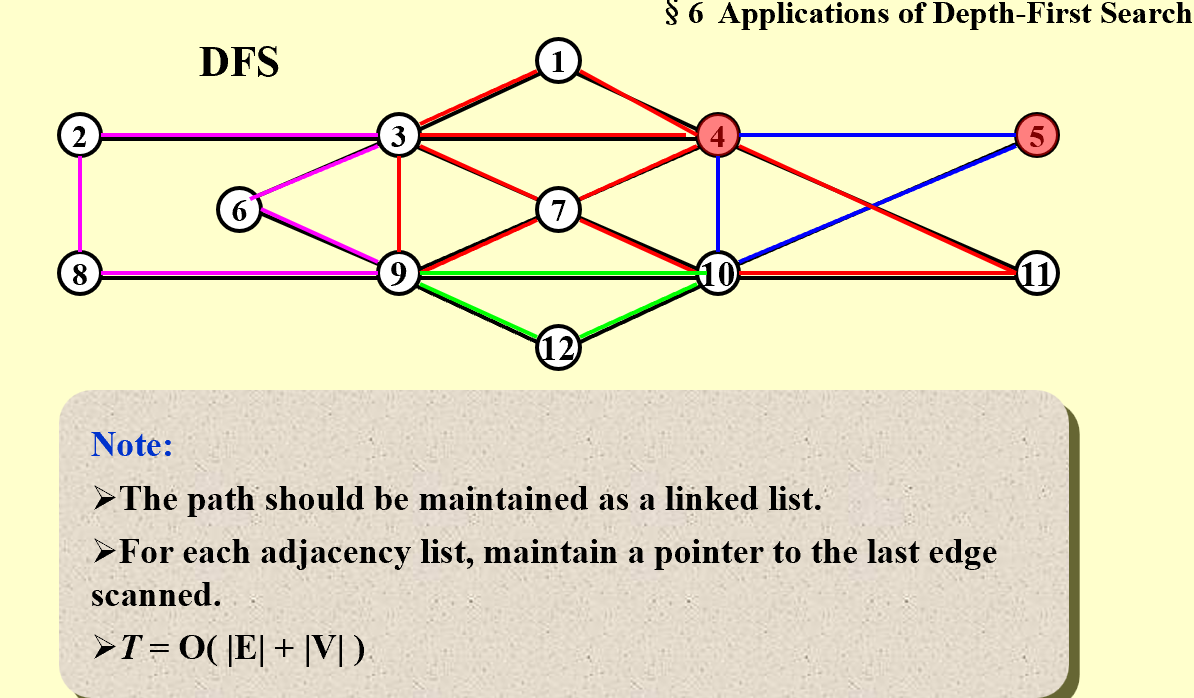
怎么找欧拉回路呢,我们看这个图,从5开始dfs,假设
5->10->4->5
回来了,对5来说dfs结束,所以我们记下4-5这条边,或者说,记下5,让它入栈
接着回溯到4,4->1->3->7->10->11->4->7->9->3->4,回到4,4废了,不能dfs了,记下4,入栈
这时dfs会回溯到3,3->2->8->9->6->3,3废了,记下3,3入栈
这时dfs回溯到6,也废了,6入栈
回溯到9,9->12->10->9,9入栈
接着一顿回溯,10入栈,12入栈,9入栈…
最后把栈的元素依次出栈就得到欧拉回路
note中,用链表维护路径,是为了可以头插法入栈,我们知道,第一步,如5->10其实是最后入栈,所以头插法入栈,输出链表就能得到5->10->…(我又想了想,好像也没必要吧,数组也可以?)
要用邻接表实现,而且给每个顶点 u 维护一个指针cur[u],记录当前应该处理的邻接边的位置。每次处理完cur[u]指向的边后,就把cur[u]向后移动一位,这样:
每条边只会被扫描一次,不会重复处理。
不需要 visited 数组,因为处理过的边再也不会被访问到
最后得到的时间复杂度就是$O(E+V)$
2.3 Tarjan’s Algorithm
Write a program to find the strongly connected components in a digraph.
1
2
3
4
5
6
7
8
9
10
11
12
13
14
15
16
17
18
19
20
21
22
23
24
25
26
27
28
29
30
31
32
33
34
35
36
| #include <stdio.h>
#include <stdlib.h>
#define MaxVertices 10
typedef int Vertex;
typedef struct VNode *PtrToVNode;
struct VNode {
Vertex Vert;
PtrToVNode Next;
};
typedef struct GNode *Graph;
struct GNode {
int NumOfVertices;
int NumOfEdges;
PtrToVNode *Array;
};
Graph ReadG();
void PrintV( Vertex V )
{
printf("%d ", V);
}
void StronglyConnectedComponents( Graph G, void (*visit)(Vertex V) );
int main()
{
Graph G = ReadG();
StronglyConnectedComponents( G, PrintV );
return 0;
}
|
1
2
3
4
5
6
7
8
9
10
11
12
13
14
15
16
17
18
19
20
21
22
23
24
25
26
27
28
29
30
31
32
33
34
35
36
37
38
39
40
41
42
43
44
45
46
47
48
49
50
51
52
53
54
55
56
57
58
59
60
61
62
63
64
65
66
67
68
69
70
71
72
73
74
75
| void tarjan(void (*visit)(Vertex V), int* belong, int* stack, int* top, int* dfn, int* low,Graph g, Vertex u, int* timer)
{
dfn[u] = low[u] = ++(*timer);
stack[++(*top)] = u;
PtrToVNode p = g->Array[u];
while(p != NULL)
{
Vertex nexe = p->Vert;
if(dfn[nexe]==-1)
{
tarjan(visit, belong, stack, top, dfn, low, g, nexe, timer);
if(low[nexe] < low[u])
{
low[u] = low[nexe];
}
}
else if(belong[nexe]==-1)
{
if(dfn[nexe] < low[u])
{
low[u] = dfn[nexe];
}
}
p = p->Next;
}
if(dfn[u] == low[u])
{
Vertex vertex;
vertex = stack[(*top)--];
visit(vertex);
belong[vertex] = 2;
while(u != vertex)
{
vertex = stack[(*top)--];
visit(vertex);
belong[vertex] = 2;
}
printf("\n");
}
}
void StronglyConnectedComponents( Graph G, void (*visit)(Vertex V) )
{
int n = G->NumOfVertices;
int* dfn = malloc(sizeof(int)*n);
int* low = malloc(sizeof(int)*n);
int* stack = malloc(sizeof(int)*n);
int* belong = malloc(sizeof(int)*n);
int top = -1;
int timer = 0;
for(int i = 0;i<n;++i)
{
dfn[i] = -1;
belong[i] = -1;
}
for(int i = 0;i<n;++i)
{
if(dfn[i] == -1)
{
tarjan(visit, belong, stack, &top, dfn, low, G, i, &timer);
}
}
free(stack);
free(dfn);
free(low);
free(belong);
}
|