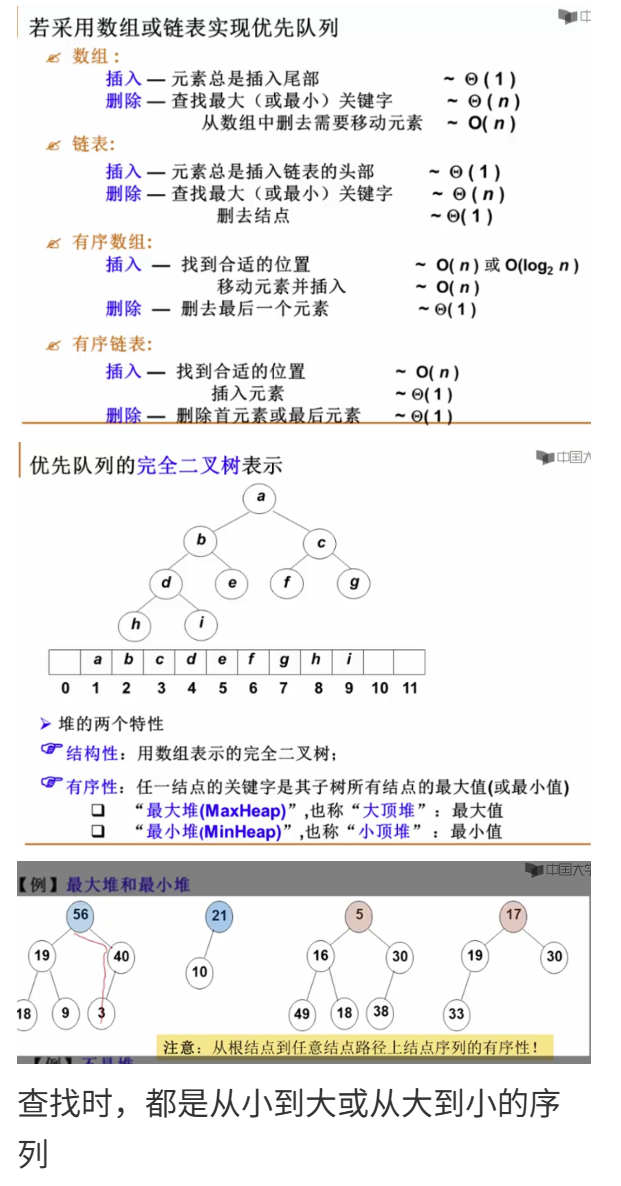
1 Heap (Priority Queue) 优先队列:出队不是先进的出,而是有优先级
2 Binary Heap The implementation we will use is known as a binary heap
It is easy to show that a complete binary tree of height $h$ has between $2^h$ and $2^{h+1} - 1$ nodes. This implies that the height of a complete binary tree is $\left \lfloor log N \right \rfloor$, which is clearly $O(log n)$
我们可以用数组来表示完全二叉树,根的下标为1,按层序编号即可。对于下标为$i$的结点
A min tree is a tree in which the key value in each node is no larger than the key values in its children (if any). A min heap is a complete binary tree that is also a min tree.
2.1 Initialize 1 2 3 4 5 6 7 8 9 10 11 12 13 14 15 16 17 18 19 typedef struct Heap * MinHeap ;struct Heap { ElementType* elements; int size; int capacity; }; MinHeap Createheap (int maxsize) { MaxHeap heap = malloc (sizeof (struct Heap)); heap->elements = malloc ((maxsize+1 )*sizeof (ElementType)); heap->size = 0 ; heap->capacity = maxsize; heap->elements[0 ] = mindata; return heap; }
2.2 Insert 插入的算法:
1 2 3 4 5 6 7 8 9 10 11 12 13 14 15 16 17 18 19 20 21 22 23 24 25 26 void Insert (MinHeap heap,ElementType item) { int i = 0 ; if (IsFull(heap)) { puts ("最小堆已满" ); return ; } i = ++heap->size; for (;heap->elements[i/2 ] > item;i/=2 ) { heap->elemets[i] = heap->elements[i/2 ]; } heap->elements[i] = item; } int IsFull (MinHeap heap) { return heap->size >= heap->capacity; }
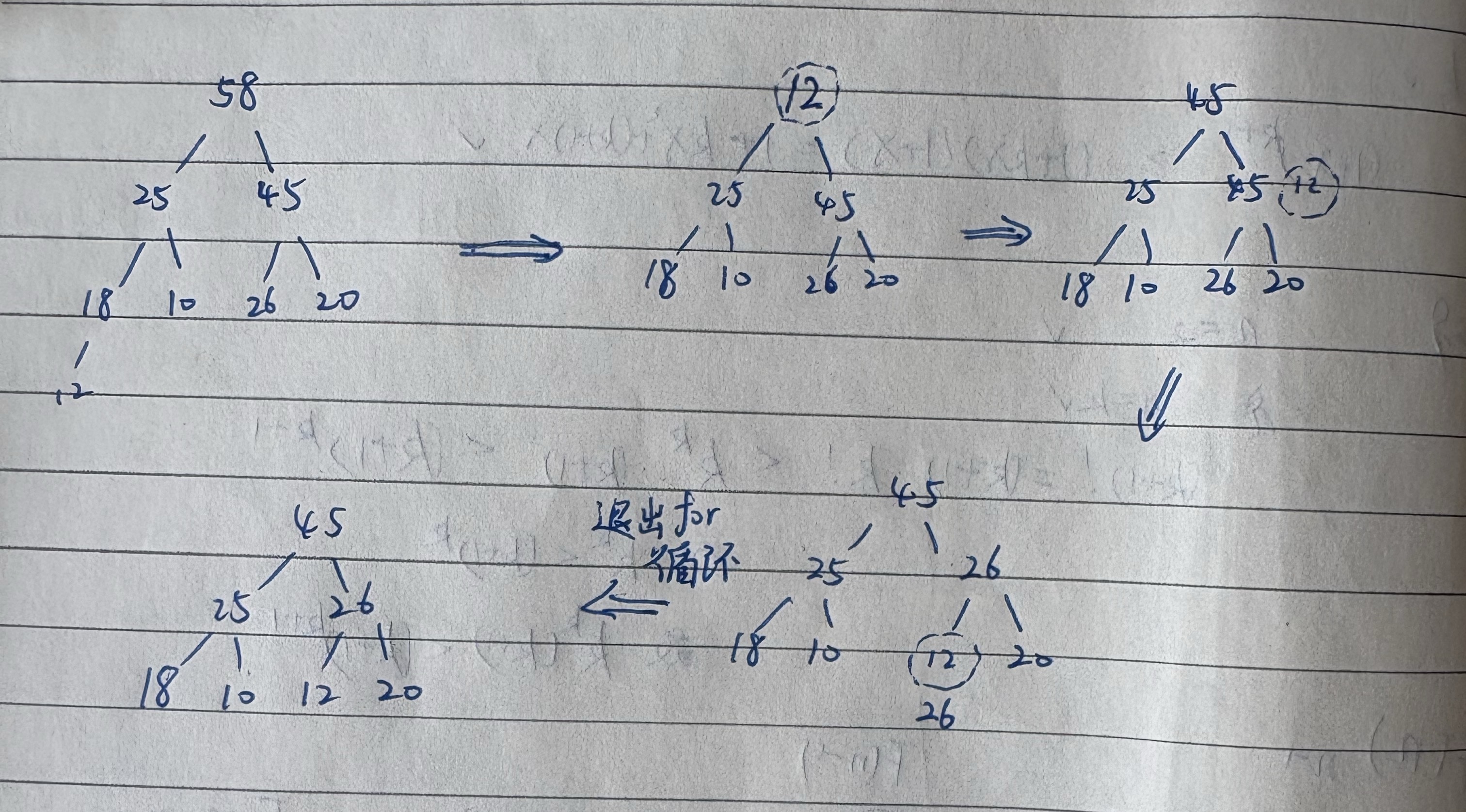
2.3 Delete 最大/最小堆中删除就是删除根结点,但要保证删完依然是最大/最小堆
完全二叉树的最后一个元素跟根交换并删掉最后一个结点(size–),这时根被删除了,但问题是我们要调整这个堆使它依然是最小堆
然后最后一个元素(tmp)开始跟左右儿子比,如果tmp比左右儿子中最小的还小,那就待在那里;或者tmp没有左儿子(自然就没有右儿子),也停止
如果两个儿子中最小的比tmp小,那么它跟tmp交换,接着重复上一步
1 2 3 4 5 6 7 8 9 10 11 12 13 14 15 16 17 18 19 20 21 22 23 24 25 26 27 28 29 30 31 32 33 34 35 36 37 38 39 40 41 42 43 44 45 46 47 48 49 50 51 52 53 54 ElementType Deleteinx (MinHeap heap) { if (IsEmpty(heap)) { puts ("最小堆已空" ); return ERROR; } ElementType min = heap->elements[1 ]; ElementType tmp = heap->elements[heap->size--]; int parent = 0 ; int child = 0 ; for (parent = 1 ;parent*2 <= heap->size;parent = child) { child = parent*2 ; if (child!=heap->size && heap->elements[child]>heap->elements[child+1 ]) { child++; } if (tmp <= heap->elements[child]) { break ; } else { heap->elements[parent] = heap->elements[child]; } } heap->elements[parent] = tmp; return min; } int IsEmpty (MinHeap heap) { return heap->size == 0 ; }
2.4 Other Operations 对于最小堆,如果我们知道某个结点的位置,
要增加它的key,那么增加后要进行下滤(percolate down)
如果要减少它的key,那么减少后要上滤(percolate up)
删除这个结点,那么等于把这个结点的值减小到负无穷,然后上滤,最后这个结点会出现在根的位置,然后对堆进行删除即可。
2.5 Build Heap 给n个元素,如何建立最大堆呢?
对n个元素,每个都执行一次插入,时间复杂度为$Nlog_2N$
先把n个元素输入进去,形成完全二叉树,再调整位置
我们考虑第2种,借鉴删除的操作
所以我们先找到最后一个结点的父结点,这个父结点的左右子树都是堆,因为就一个元素
1 2 3 4 5 6 7 8 9 10 11 12 13 14 15 16 17 18 19 20 21 22 23 24 25 26 27 28 29 30 31 32 33 34 35 36 37 38 39 40 41 42 43 44 45 46 47 48 49 50 51 52 53 54 void Build_MaxHeap (MaxHeap heap) { int last_father = heap->size / 2 ; for (int i = last_father;i>=1 ;i--) { PercDown(heap,i); } } void PercDown (MaxHeap heap,int i) { ElementType tmp = heap->elements[i]; int parent = 0 ; int child = 0 ; for (parent = i;parent*2 <= heap->size;parent = child) { child = parent*2 ; if (child!=heap->size && heap->elements[child]<heap->elements[child+1 ]) { child++; } if (tmp >= heap->elements[child]) { break ; } else { heap->elements[parent] = heap->elements[child]; } } heap->elements[parent] = tmp; }
最坏情况就是每次都要移元素,即操作了各结点高度之和次
2.6 Percolate Down/Percolate Up 我们可以看到,上滤/下滤操作在堆中是很常见的,下面一道练习题。
Exercise
1 2 3 4 5 6 7 8 9 10 11 12 13 14 15 16 17 18 19 20 21 22 23 24 25 26 27 28 29 30 31 32 33 34 35 36 37 38 39 40 41 42 43 44 45 46 47 48 49 50 51 52 53 54 55 56 57 58 59 60 61 #include <stdio.h> #include <stdlib.h> typedef int ElementType;#define MinData -1 typedef struct HeapStruct *PriorityQueue ;struct HeapStruct { ElementType *Elements; int Capacity; int Size; }; PriorityQueue Initialize ( int MaxElements ) ; void PercolateUp ( int p, PriorityQueue H ) ;void PercolateDown ( int p, PriorityQueue H ) ;void Insert ( ElementType X, PriorityQueue H ) { int p = ++H->Size; H->Elements[p] = X; PercolateUp( p, H ); } ElementType DeleteMin ( PriorityQueue H ) { ElementType MinElement; MinElement = H->Elements[1 ]; H->Elements[1 ] = H->Elements[H->Size--]; PercolateDown( 1 , H ); return MinElement; } int main () { int n, i, op, X; PriorityQueue H; scanf ("%d" , &n); H = Initialize(n); for ( i=0 ; i<n; i++ ) { scanf ("%d" , &op); switch ( op ) { case 1 : scanf ("%d" , &X); Insert(X, H); break ; case 0 : printf ("%d " , DeleteMin(H)); break ; } } printf ("\nInside H:" ); for ( i=1 ; i<=H->Size; i++ ) printf (" %d" , H->Elements[i]); return 0 ; }
请写出函数
1
2
3
4
5
6
7
8
9
10
11
12
13
14
15
16
17
18
19
20
21
22
23
24
25
26
27
28
29
30
31
32
33
34
35
36
37
38
39
void PercolateUp ( int p, PriorityQueue H ) { int tmp = H->Elements[p]; int i = p; for (;H->Elements[i/2 ] > tmp && i > 1 ;i/=2 ) { H->Elements[i] = H->Elements[i/2 ]; } H->Elemnts[i] = tmp; } void PercolateDown ( int p, PriorityQueue H ) { int parent = p; int child = 0 ; for (parent = p;parent*2 <= H->Size; parent = child) { child = parent*2 ; if (child+1 <= H->Size && H->Elements[child] > H->Elements[child+1 ]) { child++; } if (H->Elements[child] < H->Elements[parent]) { int tmp = H->Elements[child]; H->Elements[child] = H->Elements[parent]; H->Elements[parent] = tmp; } else { break ; } } }