Chapter 1 - Algorithm Analysis(b)
0 Solution to Exercise 1 Compare the Algorithms
Problem
Given(possibly negative) integers
1.1 Algorithm 01 1 2 3 4 5 6 7 8 9 10 11 12 13 14 15 16 17 18 19 20 21 22 23 24 int MaxSubsequenceSum (const int a[],int n) { int thissum = 0 ; int maxsum = 0 ; int i = 0 ; int j = 0 ; int k = 0 ; for (i=0 ;i<n;++i) { for (j=i;j<n;++j) { for (k=i;k<=j;++k) { thissum+=a[k]; } if (thissum>maxsum) { maxsum=thissum; } } } return maxsum; }
三层循环总共运行的次数为
故
1.2 Algorithm 02 1 2 3 4 5 6 7 8 9 10 11 12 13 14 15 16 17 18 19 20 21 22 23 24 25 26 int MaxSubsequenceSum (const int a[],int n) { int thissum = 0 ; int maxsum = 0 ; int i = 0 ; int j = 0 ; for (i=0 ;i<n;++i) { thissum=0 ; for (j=i;j<n;++j) { thissum+=a[j]; if (thissum>maxsum) { maxsum=thissum; } } } return maxsum; }
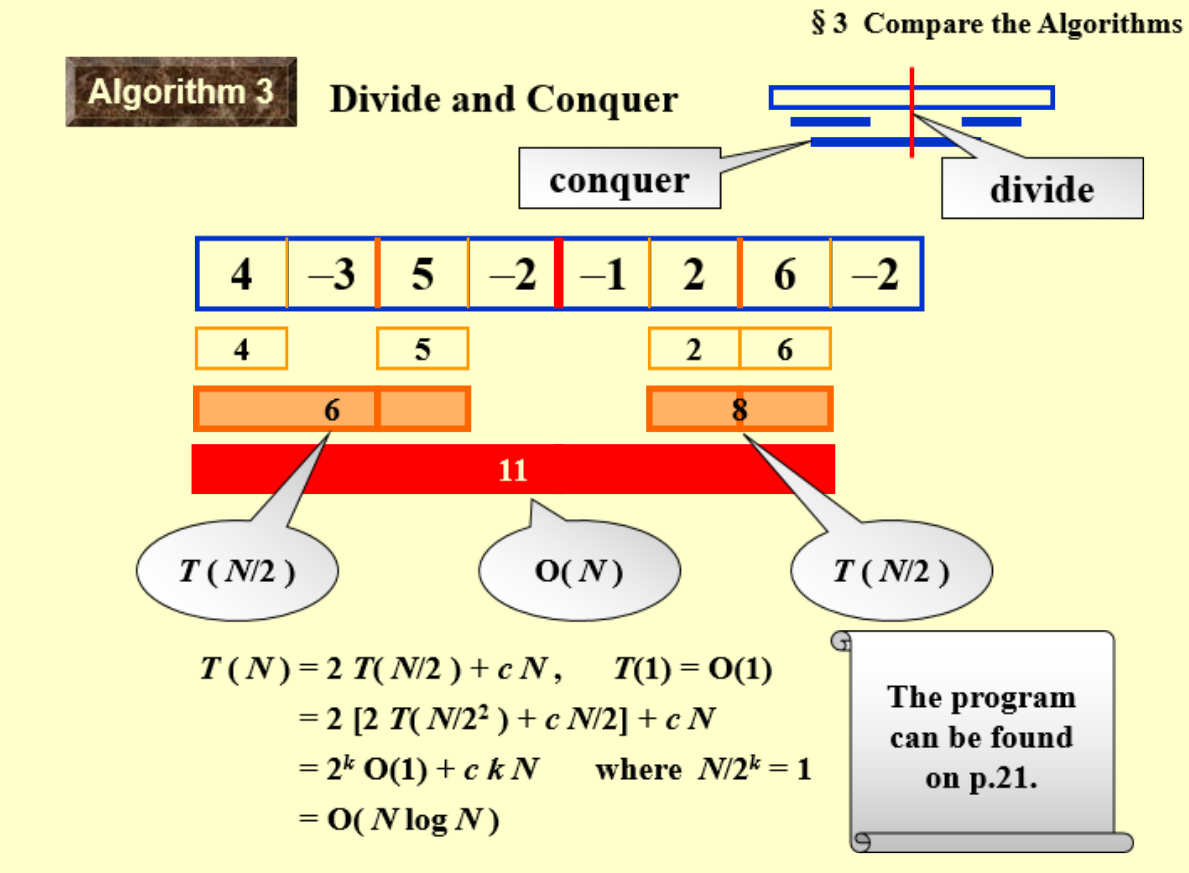
1.3 Algorithm 03 分而治之
1 2 3 4 5 6 7 8 9 10 11 12 13 14 15 16 17 18 19 20 21 22 23 24 25 26 27 28 29 30 31 32 33 34 35 36 37 38 39 40 41 42 43 44 45 46 47 48 49 int MaxSubsequenceSum (const int a[],int n) { return MaxSubSum(a,0 ,n-1 ); } int MaxSubSum (const int a[],int left,int right) { if (left==right) { if (a[left]>0 ) { return a[left]; } return 0 ; } int mid = (left+right)/2 ; int max_right_sum = MaxSubSum(a,mid+1 ,right); int max_left_sum = MaxSubSum(a,left,mid); int max_right_border_sum = 0 ; int right_border_sum = 0 ; for (int i = mid+1 ;i<=right;++i) { right_border_sum += a[i]; if (right_border_sum > max_right_border_sum) { max_right_border_sum = right_border_sum; } } int max_left_border_sum = 0 ; int left_border_sum = 0 ; for (int i = mid;i>=left;++i) { left_border_sum += a[i]; if (left_border_sum > max_left_border_sum) { max_left_border_sum = left_border_sum; } } int border_sum = max_left_border_sum+max_right_border_sum; return max(border_sum,max_left_sum,max_right_sum); }
1.4 Algorithm 04(on-line algorithm) 1 2 3 4 5 6 7 8 9 10 11 12 13 14 15 16 17 18 19 20 21 22 23 24 25 26 27 int MaxSubsequenceSum (const int a[],int n) { int i = 0 ; int thissum = 0 ; int maxsum = 0 ; for (i=0 ;i<n;++i) { thissum+=a[i]; if (thissum > maxsum) { maxsum = thissum; } else if (thissum < 0 ) { thissum = 0 ; } } return maxsum; }
2 Logarithms in the Running Time Besides divide-and-conquer algorithms, the most frequent appearance of logarithms centers around the following general rule: An algorithm is O(log n) if it takes constant (O(1)) time to cut the problem size by a fraction (which is usually ).
2.1 Binary Search 见上一节
2.2 Euclid’s Algorithm 1 2 3 4 5 6 7 8 9 10 int gcd (int m,int n) { while (n > 0 ) { rem = m % n; m = n; n = rem; } return m; }
例如50%15=5,50/15=3
Theorem 2.1
If
根据算法,两次循环后,m就会变为m%n,所以两次循环后m至少减半,而我们知道一旦开始循环,一次循环中,m的值就是上一次n的值
2.3 Exponentiation 比较直接的方法是乘n次x,复杂度为
1 2 3 4 5 6 7 8 9 10 11 12 13 14 15 16 17 int pow (int x,int n) { if (n==0 ) { return 1 ; } if (n==1 ) { return x; } if (n%2 ==0 ) { return pow (x*x,n/2 ); } return pow (x*x,n/2 ) * x; }
n每次调用都会减半,调用
3 Exercise 分析下面程序的时间复杂度
1
2
3
4
5
6
7
8
9
10
11
12
13
14
15
16
int pow (int x,int n) { if (n==0 ) { return 1 ; } if (n==1 ) { return x; } if (n%2 ==0 ) { return pow (x,n/2 )*pow (x,n/2 ); } return pow (x,n/2 )*pow (x,n/2 ) * x; }