1 Preliminaries
Definition
A tree is a collection of nodes.The collection can be empty;otherwise, a tree consists of
a root
0 or more nonempty subtrees
一棵树有n个结点,除了root,每个结点上面都有一条边,所以这棵树有n-1条边
结点的度(degree of a node): 这个结点的子树的个数
树的度: 这棵树每个结点的度的最大值
parent: 有子树的结点
children: the roots of the subtrees of a parent
sibilings: children of the same parent
leaf: a node with degree 0
path from $n_1$ to $n_k$: 在树中从$n_1$到$n_k$的序列,由于子树不能有交集,所以这个路径是唯一的
length of path: number of edges on the path
depth of $n_i$: 从根到这个结点的路径长度,根的深度是0,例如根的孩子深度是1(有些也规定为根的深度是1,即全部+1)
height of $n_i$: 从$n_i$到一个叶结点的最长路径长度
height(depth) of a tree: root的height
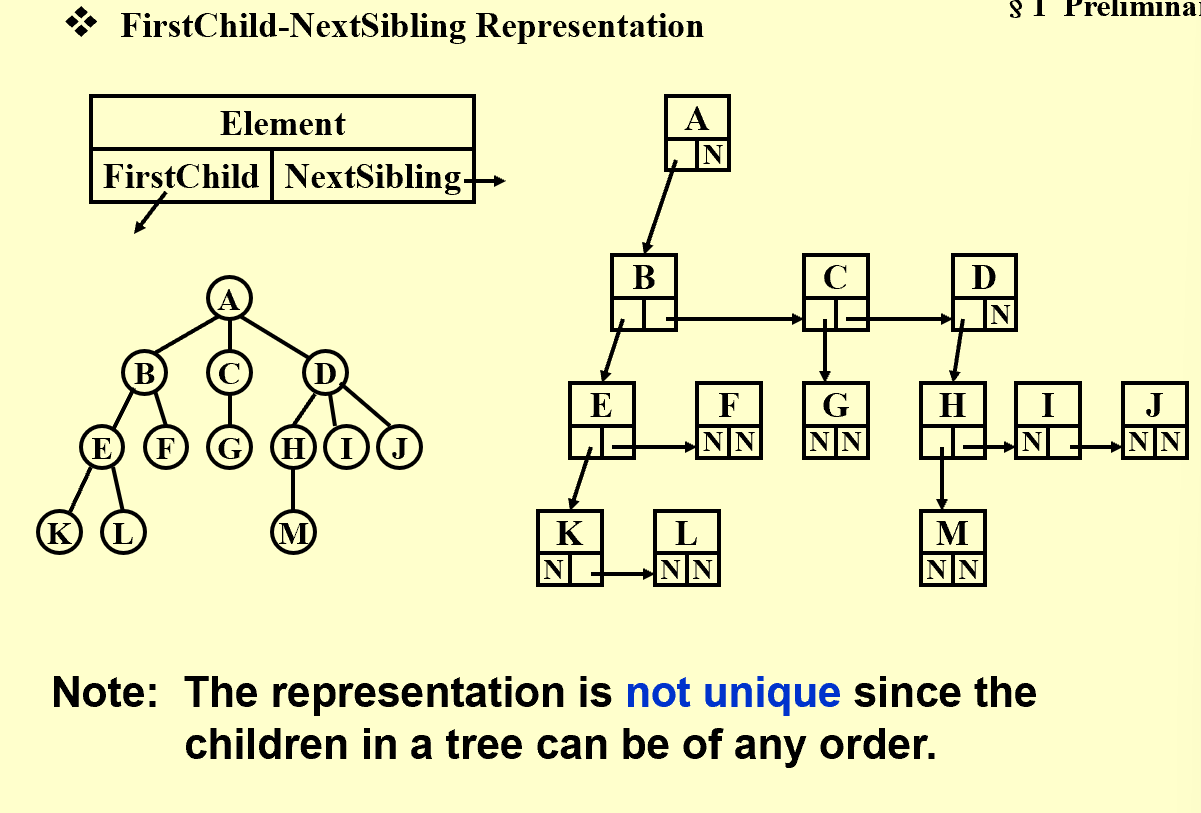
2 Implemention 直接用链表的话,每个结点无法统一,比如根可能有3个child,它的第一个child只有1个child,它的第二个child有5个child,第三个child没有child
可以使用FirstChild-NextSibiling Representation
3 Binary Trees A binary tree is a tree in which no node can have more than two children.二叉树的子树有左右之分
性质:
一个二叉树第i层最大结点数是$2^{i-1}$
深度为k的二叉树的最大总结点数是$2^{k+1}-1$
对任何非空二叉树,$n_0$表示叶结点个数,$n_2$是度为2的结点个数,那么$n_0=n_2+1$
证明:边数,除了root,每个结点的上面都有一条边,边数为$n_0+n_1+n_2-1$,再考虑每个结点下面的边,边数为$2n_2+n_1$,两者相等即得证
3.1 Expression Tree 例 已知后缀表达式 ab+cde+**
对这棵树中序遍历,就得到中缀表达式,后序遍历就得到后缀表达式,前序遍历就得到前缀表达式
ai的实现
1 2 3 4 5 6 7 8 9 10 11 12 13 14 15 16 17 18 19 20 21 22 23 24 25 26 27 28 29 30 31 32 33 34 35 36 37 38 39 40 41 42 43 44 45 46 47 48 49 50 51 52 53 54 55 56 57 58 59 60 61 62 63 64 65 66 67 68 69 70 71 72 73 74 75 76 77 78 79 80 81 82 83 84 85 86 87 88 #include <stdio.h> #include <stdlib.h> #include <ctype.h> typedef struct TreeNode { char data; struct TreeNode *left ; struct TreeNode *right ; } TreeNode; TreeNode* createNode (char data) { TreeNode* newNode = (TreeNode*)malloc (sizeof (TreeNode)); newNode->data = data; newNode->left = newNode->right = NULL ; return newNode; } typedef struct Stack { TreeNode* array [100 ]; int top; } Stack; void push (Stack* s, TreeNode* node) { s->array [++(s->top)] = node; } TreeNode* pop (Stack* s) { return s->array [(s->top)--]; } TreeNode* buildExpressionTree (char postfix[]) { Stack s; s.top = -1 ; TreeNode *t, *t1, *t2; for (int i = 0 ; postfix[i] != '\0' ; i++) { if (isalnum (postfix[i])) { t = createNode(postfix[i]); push(&s, t); } else { t = createNode(postfix[i]); t1 = pop(&s); t2 = pop(&s); t->right = t1; t->left = t2; push(&s, t); } } return pop(&s); } void inorder (TreeNode* root) { if (root) { if (root->left) printf ("(" ); inorder(root->left); printf ("%c" , root->data); inorder(root->right); if (root->right) printf (")" ); } } int main () { char postfix[] = "ab+c*" ; printf ("后缀表达式: %s\n" , postfix); TreeNode* root = buildExpressionTree(postfix); printf ("还原中缀表达式: " ); inorder(root); printf ("\n" ); return 0 ; }
3.2 Tree Traversals 1 2 3 4 5 6 7 8 9 10 11 12 13 14 15 16 17 18 19 20 21 22 23 24 25 26 27 28 29 30 31 32 33 34 35 36 37 38 39 40 41 42 43 44 45 46 void preorder (Tree* tree) { if (tree) { visit(tree); preorder(tree->left); preorder(tree->right); } } void postorder (Tree* tree) { if (tree) { postorder(tree->left); postorder(tree->right); visit(tree); } } void inorder (Tree* tree) { if (tree) { inorder(tree->left); visit(tree); inorder(tree->right); } } void levelorder (Tree* tree) { enqueue(tree); while (queue is not empty) { visit(T=dequeue()); for (each child C of T) { enqueue(C); } } }
3.2.1 中序非递归遍历
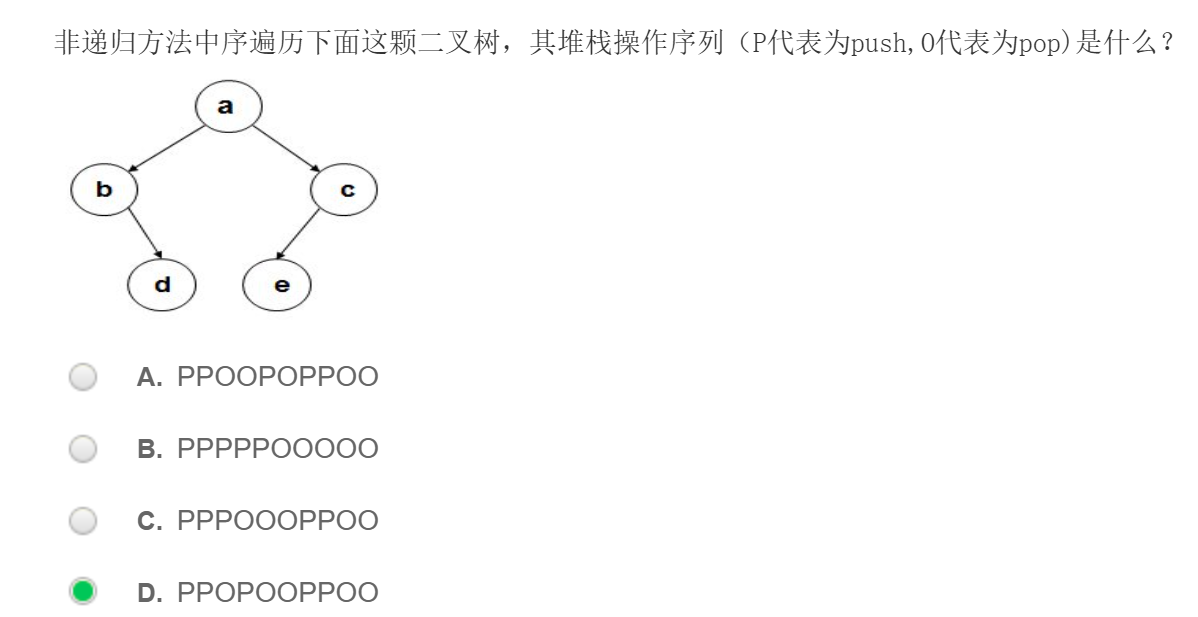
递归是栈的应用之一,所以我们可以用栈直接实现中序遍历
画图试试👇
遇到一个结点,push进去,然后遍历它的左子树
左子树遍历结束后,从栈顶pop出这个结点并访问它
然后按它的右指针再去中序遍历该结点右子树(回到第一步)
对上图
遇到a,把a push进去,再到b
遇到b依然执行第一步,==把b push进去==,由于左指针空,到第二步,==pop出b==并打印元素,然后b进行第三步,到d
d再执行第一步,把d push进去,左空,pop出d,右空
这时a的第一步结束了,来到第二步,==pop出a==并打印元素
来到a的第三步,到c,再对c执行三个步骤。push c,push e,pop出e,pop出c,c的右指针为空,结束a的第三步
1 2 3 4 5 6 7 8 9 10 11 12 13 14 15 16 17 18 19 20 21 22 23 24 25 26 27 28 29 30 31 32 33 34 35 36 37 38 39 40 41 42 43 44 45 46 47 48 49 50 51 52 53 54 55 56 57 58 59 60 61 62 63 64 65 66 67 68 69 70 71 72 73 74 75 76 77 78 79 80 81 82 83 84 85 86 87 88 89 90 typedef struct SNode { ElementType data; struct SNode * next ; }SNode; SNode* Creatstack () { SNode* head = (SNode*)malloc (sizeof (SNode)); head->next = NULL ; return head; } int Isempty (SNode* head) { return (head->next==NULL ) } void Push(SNode* head,ElementType x){ SNode* new = malloc (sizeof (SNode)); if (new==NULL ) { puts ("error" ); return ; } new->data = x; new->next = head->next; head->next = new; } ElementType Pop (SNode* head) { if (Isempty(head)) { puts ("Empty Stack" ); return ERROR; } SNode tmp = head->next; head->next = tmp->next; ElementType pop_element = tmp->data; free (tmp); return pop_element; } typedef struct TreeNode * Tree struct TreeNode { int element; Tree left; Tree right; }; typedef struct SNode { Tree bintree; struct SNode * next ; }SNode; void InorderTraversal (Tree bintree) { SNode* stack = Createstack(); while (bintree || !Isempty(stack )) { while (bintree) { Push(stack ,bintree); bintree = bintree->left; } if (!Isempty(stack )) { bintree = Pop(stack ); printf ("%d\n" ,bintree->element); bintree = bintree->right; } } }
事实上,中序、先序、后序遍历中每个结点只是访问时机不同,所以上面的程序,只要把printf的顺序改变,就变成先/后序遍历
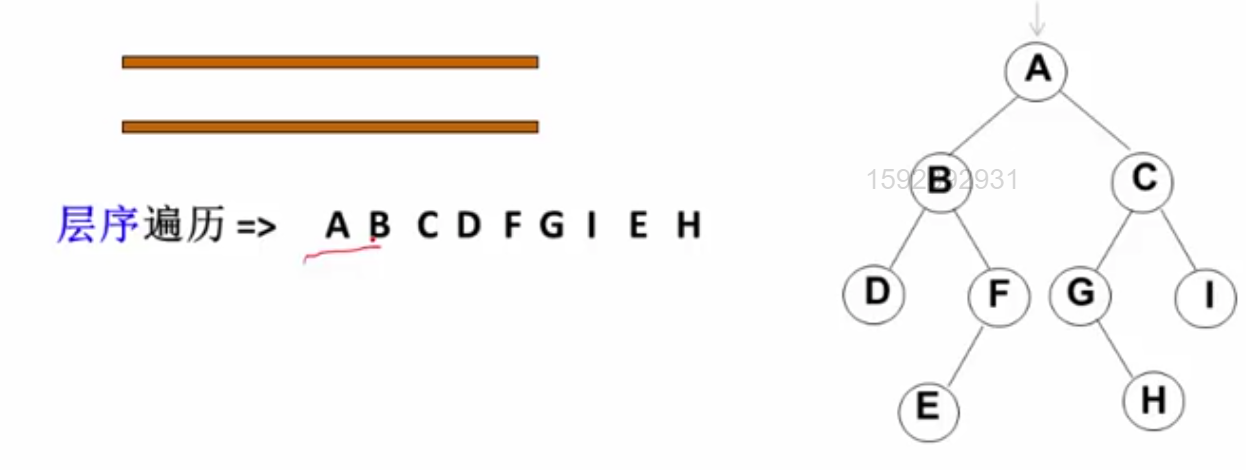
3.2.2 层序遍历实现
对二叉树的遍历实际上是把二维结构线性化的过程,比如访问左儿子后,怎么回到父结点、访问右儿子,需要用到存储结构栈、队列保存暂时未访问的结点
画图试试👇
从队列取出一个元素(结点的指针)
访问该元素所指结点
将该元素所指结点的左、右child入队,回到第一步
1 2 3 4 5 6 7 8 9 10 11 12 13 14 15 16 17 18 19 20 21 22 23 24 25 26 27 28 29 30 31 32 33 34 35 36 37 38 39 40 41 42 43 44 45 46 47 48 49 50 51 52 53 54 55 56 57 58 59 60 61 62 63 64 65 66 67 68 69 70 71 72 73 74 75 76 77 78 79 80 81 82 83 84 85 86 87 88 89 90 91 92 93 94 95 96 97 98 99 100 101 102 103 104 105 106 107 108 109 110 111 112 typedef struct TreeNode * Tree ;struct TreeNode { int element; Tree left; Tree right; }; struct Node { Tree bintree; struct Node * next ; }; typedef struct { struct Node * front ; struct Node * rear ; }QNode; QNode* Createqueue () { QNode* q = malloc (sizeof (QNode)); if (q==NULL ) { puts ("创建队列失败" ); return NULL ; } q->front = NULL ; q->rear = NULL ; return q; } int Isempty (QNode* q) { return q->front==NULL ; } void EnQueue (QNode* q,Tree x) { struct Node * new =malloc (sizeof (struct Node)); if (new==NULL ) { puts ("内存分配失败" ); return ; } new->bintree = x; new->next = NULL ; if (Isempty(q)) { q->rear = new; q->front = new; } else { q->rear->next = new; q->rear = new; } } Tree DeQueue (QNode* q) { if (Isempty(q)) { puts ("空队列,无法出队" ); return NULL ; } Tree tmp = q->front->bintree; struct Node * tmpptr = if (q->front==q->rear) { q->front = NULL ; q->rear = NULL ; } else { q->front = q->front->next; } free (tmpptr); return tmp; } void LevelOrderTraversal (Tree bintree) { if (!bintree) { return ; } QNode* q = Createqueue(); EnQueue(q,bintree); Tree tmp; while (!Isempty(q)) { tmp = DeQueue(q); printf ("%d\n" ,tmp->element); if (tmp->left) { EnQueue(q,tmp->left); } if (tmp->right) { EnQueue(q,tmp->right); } } }
1 2 3 4 5 6 7 8 9 10 11 12 13 14 15 16 17 18 19 20 21 22 #include <stdio.h> #include <stdlib.h> int main () { struct TreeNode a =1 }; struct TreeNode b =2 }; struct TreeNode c =3 }; struct TreeNode d =4 }; struct TreeNode e =5 }; struct TreeNode f =6 }; a.left = &b; a.right = &c; b.left = &d; b.right = &e; e.left = &f; LevelOrderTraversal(&a); return 0 ; }
3.2.3 遍历应用例子 输出二叉树叶结点
1
2
3
4
5
6
7
8
9
10
11
12
void PreOrderPrintLeaves (Tree bintree) { if (bintree) { if (!bintree->left && !bintree->right) { printf ("%d\n" ,bintree->element); } PreOrderPrintLeaves(bintree->left); PreOrderPrintLeaves(bintree->right); } }
求二叉树高度
1
2
3
4
5
6
7
8
9
10
11
12
int PostOrderGetHeight (Tree bintree) { if (bintree) { int HL = PostOrderGetHeight(bintree->left); int RL = PostOrderGetHeight(bintree->right); int max = (HL>RL)?HL:RL; return max+1 ; } return 0 ; }
先序+中序或后序+中序可以确定二叉树
根据先序序列第一个结点找到root
中序中的根结点左右分别是左子树、右子树
对左子树、右子树用相同方法分解
如
根为a,左子树为cbed,右子树为hgijf
Problem Description :Suppose that all the keys in a binary tree are distinct positive integers. Given the preorder and inorder traversal sequences, you are supposed to output the level-order traversal sequence of the corresponding binary tree, and find the maximum width of the tree. The width of a level is defined as the number of nodes in that level.
Input Specification :Each input file contains one test case. For each case, the first line contains a positive integer $N$ ($\le 30$), which is the total number of nodes in the tree. The second line contains the preorder sequence and the third line contains the inorder sequence. All the numbers in a line are separated by a space.
Output Specification :For each test case, first print the level-order traversal sequence in one line. All the numbers must be separated by exactly one space, and there must be no extra space at the end of the line.In the second line, print the total depth and the maximum width of the tree, separated by one space.
解答
1 2 3 4 5 6 7 8 9 10 11 12 13 14 15 16 17 18 19 20 21 22 23 24 25 26 27 28 29 30 31 32 33 34 35 36 37 38 39 40 41 42 43 44 45 46 47 48 49 50 51 52 53 54 55 56 57 58 59 60 61 62 63 64 65 66 67 68 69 70 71 72 73 74 75 76 77 78 79 80 81 82 83 84 85 86 87 88 89 90 91 92 93 #include <stdio.h> #include <stdlib.h> typedef struct TreeNode { int data; struct TreeNode * left ; struct TreeNode * right ; }TreeNode; TreeNode* buildTree (int * pre, int * in, int n) { if (n <= 0 ) { return NULL ; } int r = pre[0 ]; int i = 0 ; for (i=0 ;i<n;++i) { if (in[i]==r) { break ; } } int left = i; int right = n - 1 - i; TreeNode* root = malloc (sizeof (TreeNode)); root->data = r; root->left = buildTree(pre+1 , in, left); root->right = buildTree(pre+left+1 , in+i+1 , right); return root; } void levelOrderAnalysis (TreeNode* root, int n) { if (!root) { return ; } TreeNode* queue [100 ]; int front = 0 ; int rear = 0 ; int result[100 ] = {0 }; int res_count = 0 ; queue [rear++] = root; int maxDepth = 0 ; int maxWidth = 0 ; while (front < rear) { int size = rear - front; if (size > maxWidth) { maxWidth = size; } maxDepth++; for (int i = 0 ;i<size;++i) { TreeNode* cur = queue [front++]; result[res_count++] = cur->data; if (cur->left) queue [rear++] = cur->left; if (cur->right) queue [rear++] = cur->right; } } for (int i = 0 ; i < res_count; i++) { printf ("%d%c" , result[i], (i == res_count - 1 ? '\n' : ' ' )); } printf ("%d %d\n" , maxDepth, maxWidth); } int main () { int n; if (scanf ("%d" , &n) != 1 ) return 0 ; int pre[35 ], in[35 ]; for (int i = 0 ; i < n; i++) scanf ("%d" , &pre[i]); for (int i = 0 ; i < n; i++) scanf ("%d" , &in[i]); TreeNode* root = buildTree(pre, in, n); levelOrderAnalysis(root, n); return 0 ; }
4 Binary Search Tree 斜二叉树(Skewed Binary Trees)
完美二叉树(Perfect Binary Tree):所有叶子节点都在同一层,且所有内部节点的度都为2
完全二叉树(Complete Binary Tree):除最后一层外,其余层都被完全填满,并且最后一层的所有节点都尽可能地靠左排列
4.1 Definition
Definition
A binary search tree is a binary tree. It may be empty. If it is not empty, it satisfies the following properties:integer distinct
4.2 Find 1 2 3 4 5 6 7 8 9 10 11 12 13 14 15 16 17 18 19 20 21 22 23 24 25 26 27 28 29 30 31 32 33 34 35 36 37 38 39 40 41 42 43 44 45 46 47 48 49 50 51 52 53 54 55 56 57 58 59 60 61 62 63 64 65 66 67 68 69 70 71 72 73 74 75 76 77 78 79 80 81 82 83 84 85 86 87 88 89 90 91 92 typedef struct TreeNode * Tree struct TreeNode { ElementType element; Tree left; Tree right; }; Tree Find (Tree bst,ElementType x) { if (!bst) { return NULL ; } if (x > bst->element) { return Find(bst->right,x); } else if (x < bst->element) { return Find(bst->left,x); } else { return bst; } } Tree IterFind (Tree bst,ElementType x) { while (bst) { if (x > bst->element) { bst = bst->right; } else if (x < bst->element) { bst = bst->left; } else { return bst; } } return NULL ; } Tree FindMax (Tree bintree) { if (!bintree) { return NULL ; } while (bintree->right) { bintree = bintree->right; } return bintree; } Tree FindMin (Tree bintree) { if (bintree) { while (bintree->left) { bintree = bintree->left; } return bintree; } return NULL ; } Tree FindMin (Tree bintree) { if (!bintree) { return NULL ; } else if (bintree->left==NULL ) { return bintree; } else { return FindMin(bintree->left); } }
4.3 Insert
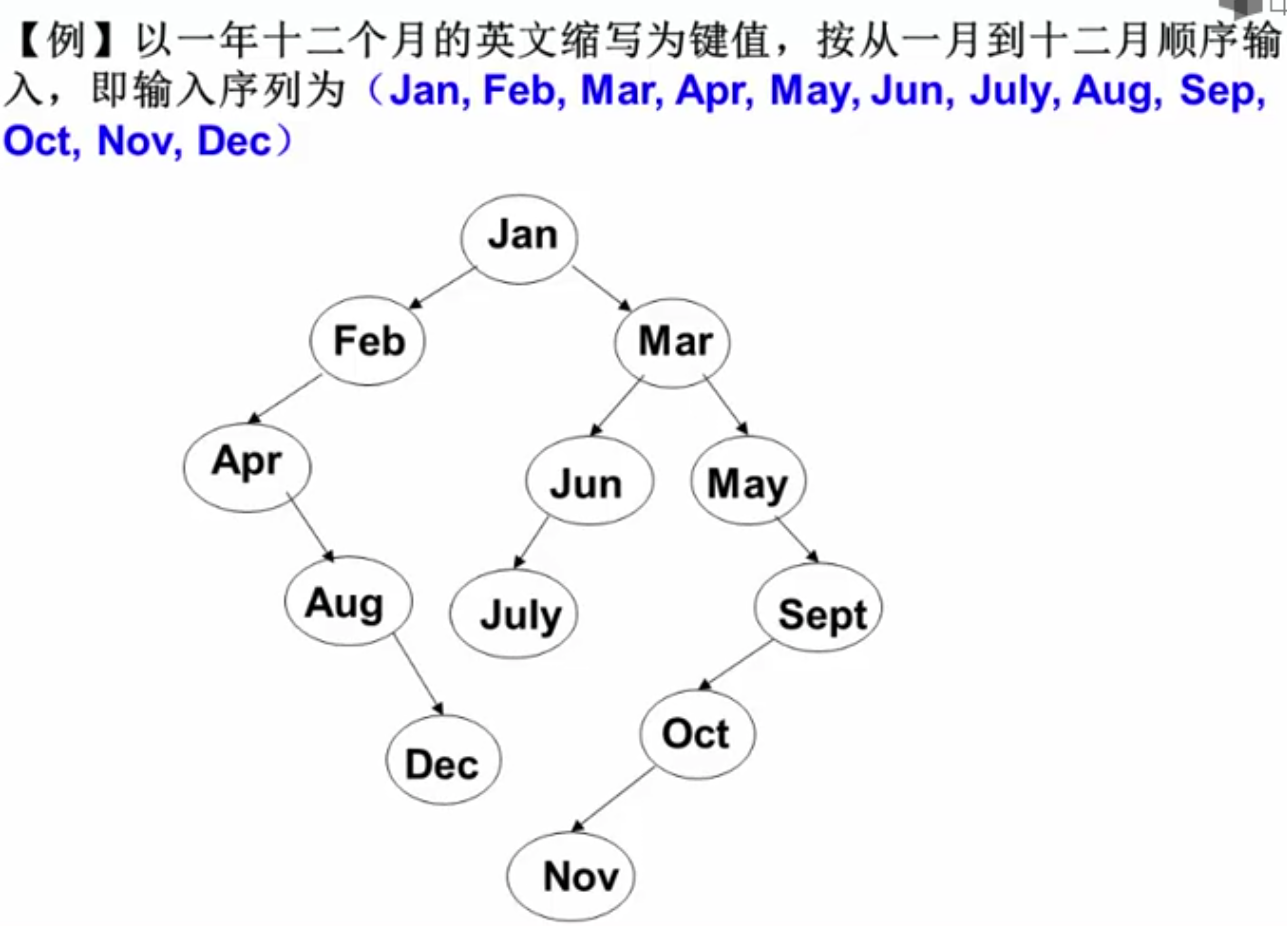
我们先来分析怎么插入,以上图为例
我们还可以从另一个角度看,首先插入这个元素前,我们要先检查它是不是在BST里,所以查找,当查到最后一个元素时,如果它在,那就不用插入了,如果它不在,那么这最后一个元素的左/右儿子一定是NULL,把它插入到这里就可以了。
就像上例插入Dec,最后一个元素是Aug,Dec比它大,而Aug的右儿子是空的,所以Dec自然地要插入到那里。
但问题是,我们怎么找到这个“最后一个元素”呢?可以借鉴查找的算法,先比较当前结点和插入结点,按照大小关系分别在左/右子树里调用插入函数,如果这个树是空的,说明这时前一次调用时的那个根就是我们要找的“最后一个元素”,上例来看,就是调用Aug->right = Insert(Aug->right,Dec)时发现Aug->right是空的。所以创建一个结点返回回去就行了
1
2
3
4
5
6
7
8
9
10
11
12
13
14
15
16
17
18
19
20
21
22
Tree Insert (ElementType x, Tree bst) { if (!bst) { bst = malloc (sizeof (struct TreeNode)); bst->left = NULL ; bst->right = NULL ; bst->element = x; } else if (x > bst->element) { bst->right = Insert(x,bst->right); } else if (x < bst->element) { bst->left = Insert(x,bst->left); } return bst; }
查找和插入的时间复杂度都是$O(D)$,$D$为树的深度
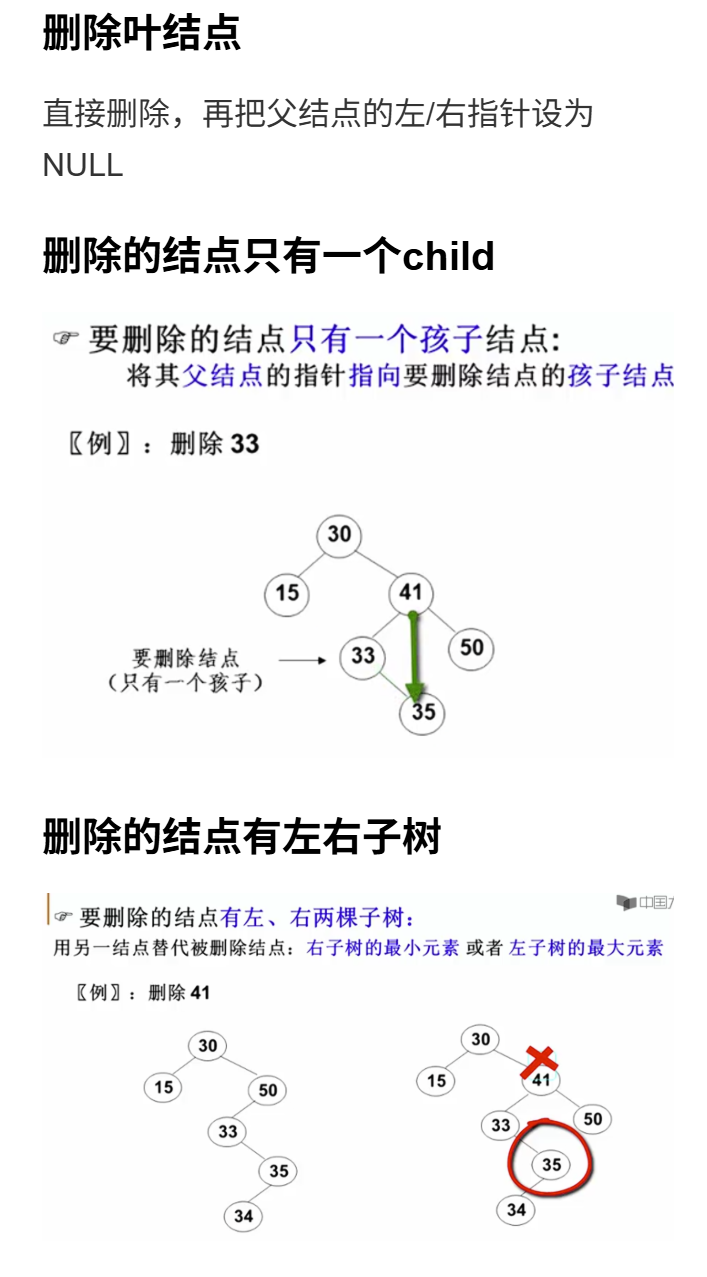
4.4 Delete
1
2
3
4
5
6
7
8
9
10
11
12
13
14
15
16
17
18
19
20
21
22
23
24
25
26
27
28
29
30
31
32
33
34
35
36
37
38
39
40
41
42
Tree Delete (ElementType x, Tree bst) { if (bst==NULL ) { Error("Element not found" ); } else if (x > bst->element) { bst->right = Delete(x,bst->right); } else if (x < bst->element) { bst->left = Delete(x,bst->left); } else { if (bst->left && bst->right) { Tree tmp = FindMin(bst->right); bst->element = tmp->element; bst->right = Delete(tmp->element,bst->right); } else { if (bst->left==NULL ) { Tree tmp = bst; bst = bst->right; free (tmp); } else if (bst->right==NULL ) { Tree tmp = bst; bst = bst->left; free (tmp); } } } return bst; }
整个删除过程分为寻找删除结点+执行删除(else部分),在递归下降查找阶段,设树的高度为h,设找到待删除结点的时间复杂度为T(h),$T(h) = T(h-1) + O(1)$,可以得到$T(h) = O(d), d$为待删除结点在原树的深度,而$O(d)=O(h)$,之后进入else分支,当有两个孩子的情况最复杂,首先FindMin是$O(h)$,删除部分由于是删除右子树最小元素,找到最小元素$O(h)$,删掉$O(1)$,因此else分支部分时间复杂度为$O(h)$
最坏情况下,$h=N$,平均和最好情况下,$h=O(logN)$