二分查找很快,但排序本身也要$O(nlogn)$
查找方式
前提条件
平均时间复杂度
顺序查找
无
O(n)
二分查找
数组有序
O(log n)
哈希查找 无
O(1) ← 目标!
1 Interpolation Search 插值查找是一种在有序数组中比二分更快的查找方式。它不是每次取中点,而是根据目标值在范围内的”比例”来估算位置:
1
2
3
i = l + (key - f[l].key) / (f[u].key - f[l].key) * (u - l) if (f[i].key < key) l=i; else u=i;
这本质上也是”用公式算位置”,是哈希思想的前身。但它依赖数据均匀分布,哈希表则更通用。
2 General Ideas 哈希表的抽象模型叫做符号表(Symbol Table) (也叫字典),它存储的是 <名字, 属性> 键值对。
现实例子 :
英语词典:名字 = 单词,属性 = 释义列表
编译器符号表:名字 = 变量名(如 int),属性 = 使用行号、类型等信息
2.1 Hash Table 哈希表 ht[] 由 b 个”桶”(bucket)组成
1
2
3
4
ht[0]: [ slot0 | slot1 | ... ] ht[1]: [ slot0 | slot1 | ...] ... ht[b-1]:[ slot0 | slot1 | ... ]
对于每个标识符 x,哈希函数 f(x) 计算出它应该放在哪个桶里,也就是放到的桶的下标
T = 所有可能键值的总数(全集大小)
n = 当前哈希表中实际存储的键的数量
s = 每个桶的槽数
b = 桶的数量
冲突(Collision) :两个不同的键 $i_1 ≠ i_2$,但 $f(i_1) = f(i_2)$,映射到了同一个桶
溢出(Overflow) :新键要插入一个已经满了 的桶
没有溢出时,利用哈希函数$f(x)$,T_search = T_insert = T_delete = O(1)
2.2 Hash Function
能为 key 计算索引之后,我们就可以知道每个键值对应的值 value 应该放在哪里了.假设我们用数组 a 存放数据,哈希函数是 f,那键值对 (key, value) 就应该放在 a[f(key)] 上.不论键值是什么类型,范围有多大,f(key) 都是在可接受范围内的整数,可以作为数组的下标.(摘自OIWiki )
哈希函数的特点
计算简单,冲突尽量少
尽量均匀,对任意键 x 和任意位置 i,P(f(x) = i) = 1/b,满足这个条件的函数称为均匀哈希函数(uniform hash function)
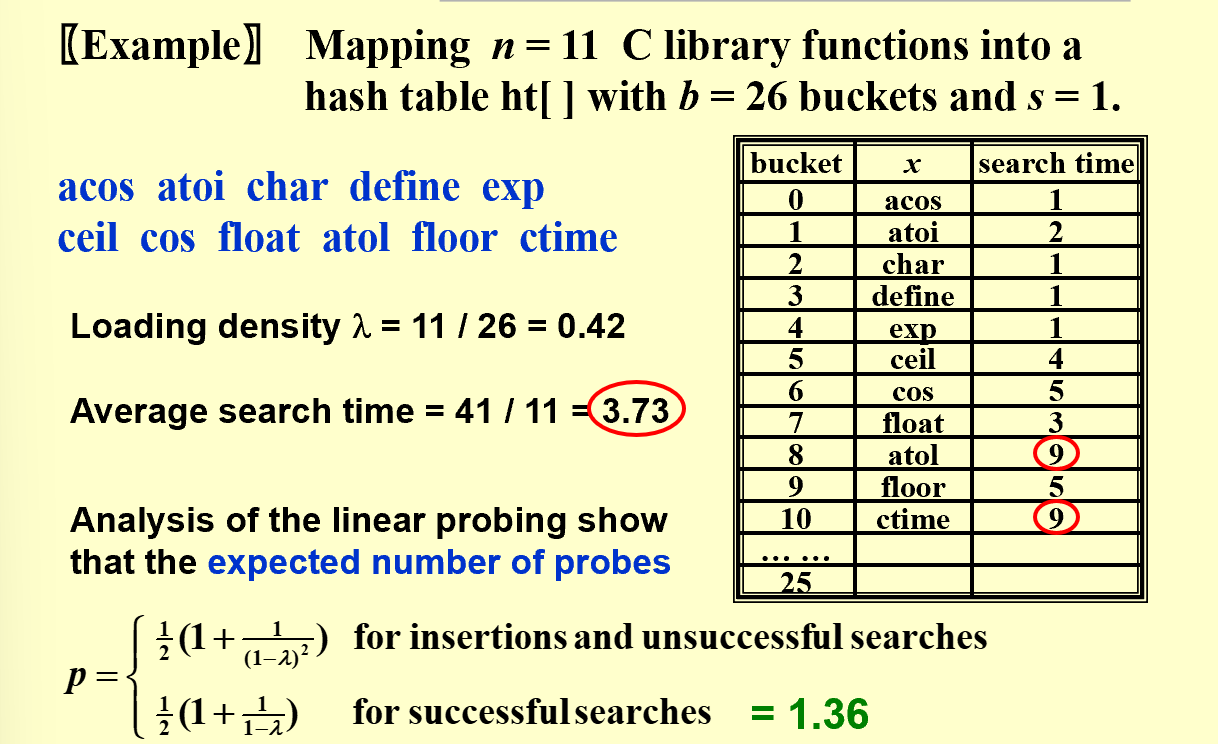
一种哈希函数是f(x) = x % TableSize
对于字符串方法一
1 2 f(x) = (sum of x[i]) % TableSize;
问题:对于 TableSize = 10,007,字符串长度 ≤ 8,字符 ASCII ∈ [0, 127],则:
f(x) 的最大值 = 127 × 8 = 1016
哈希值只会落在 [0, 1016],大量桶永远空着!
方法二:带权加法
1 f(x) = (x[0 ] + x[1 ]*27 + x[2 ]*27 *27 ) % TableSize;
把字母看成 27 进制数字,赋予不同位权重。27 27对TableSize取余
方法三
1
2
3
4
5
6
Index Hash3 (const char *x, int TableSize) { unsigned int HashVal = 0 ; while (*x != '\0' ) HashVal = (HashVal << 5 ) + *x++; return HashVal % TableSize; }
unsigned int占32位的情况下,我们以单词orchid为例
最后x[0]会位于这个“整数”(即64位01串)的最左边,但如果字符串x很长,就会只保留最后几位字符的值(前面的字符被移出去了)如果它们都一样,就可能导致冲突,所以字符的选择也很重要
3 Seperate Chaining 冲突总是存在的,怎么解决冲突呢
把所有哈希到同一个位置的键,用链表 串起来放在那个桶里。
1
2
3
4
5
ht[0] → [acos] → [atoi] → NULL ht[1] → NULL ht[2] → [char] → NULL ht[3] → [define] → NULL ...
1
2
3
4
5
6
7
8
9
10
11
12
13
14
15
16
17
18
struct ListNode ;typedef struct ListNode * Position ;struct ListNode { ElementType Element; Position Next; }; typedef Position List;struct HashTbl { int TableSize; List* TheLists; }; typedef struct HashTbl * HashTable ;
1
2
3
4
5
6
7
8
9
10
11
12
13
14
15
16
17
18
19
20
21
22
23
24
25
26
27
28
29
HashTable InitializeTable (int TableSize) { HashTable H; int i; if (TableSize < MinTableSize) { Error("Table size too small" ); return NULL ; } H = malloc (sizeof (struct HashTbl)); if (H == NULL ) FatalError("Out of space!!!" ); H->TableSize = NextPrime(TableSize); H->TheLists = malloc (sizeof (List) * H->TableSize); if (H->TheLists == NULL ) FatalError("Out of space!!!" ); for (i = 0 ; i < H->TableSize; i++) { H->TheLists[i] = malloc (sizeof (struct ListNode)); if (H->TheLists[i] == NULL ) FatalError("Out of space!!!" ); H->TheLists[i]->Next = NULL ; } return H; }
查找
1
2
3
4
5
6
7
8
9
10
11
12
13
14
15
16
Position Find (ElementType Key, HashTable H) { Position P; List L; L = H->TheLists[Hash(Key, H->TableSize)]; P = L->Next; while (P != NULL && P->Element != Key) P = P->Next; return P; }
插入
1
2
3
4
5
6
7
8
9
10
11
12
13
14
15
16
17
18
19
20
21
void Insert (ElementType Key, HashTable H) { Position Pos, NewCell; List L; Pos = Find(Key, H); if (Pos == NULL ) { NewCell = malloc (sizeof (struct ListNode)); if (NewCell == NULL ) FatalError("Out of space!!!" ); L = H->TheLists[Hash(Key, H->TableSize)]; NewCell->Next = L->Next; NewCell->Element = Key; L->Next = NewCell; } }
实践建议 :让 TableSize ≈ 预期键的数量,使 λ ≈ 1,此时每条链表平均长度为 1,接近 O(1)。
4 Open Addressing 1 2 3 4 5 6 7 8 9 10 11 12 index = hash(key); i = 0 ; while (该位置有冲突) { index = (hash(key) + f(i)) % TableSize; if (表满了) break ; else i++; } if (表满了) ERROR("No space left" ); else 在 index 处插入 key;
这里的f(x)是collision resolving function
4.1 Linear Probing $$f(i) = i$$
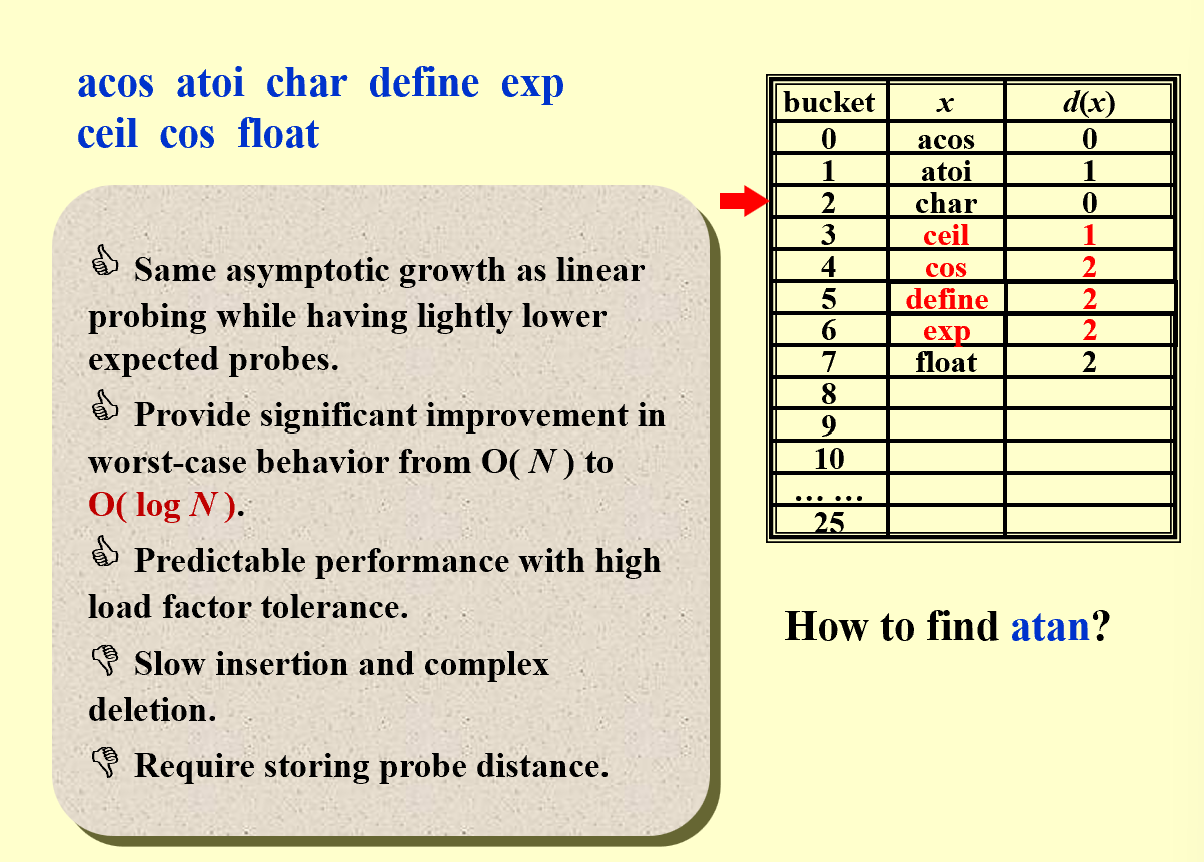
4.2 Robin Hood Hashing
定义每个键的探测距离 d(x) = (实际存储位置 - 初始哈希位置) % TableSize抢占 该位置,把原来的键往后移。
1 2 3 4 5 6 7 8 9 10 11 12 13 14 15 16 17 18 19 20 21 22 23 24 25 26 bool RobinHood_Insert (ElementType Key, HashTable H) { Position Pos = Hv = Hash(Key, H->TableSize); int CurrentDisp = 0 ; ElementType CurrentKey = Key; while (true ) { if (H->TheCells[Pos].Info != Legitimate) { H->TheCells[Pos].Info = Legitimate; H->TheCells[Pos].Element = CurrentKey; H->TheCells[Pos].Disp = CurrentDisp; return true ; } if (CurrentDisp > H->TheCells[Pos].Disp) { swap(&CurrentKey, &H->TheCells[Pos].Element); swap(&CurrentDisp, &H->TheCells[Pos].Disp); } Pos = (Pos + 1 ) % H->TableSize; if (Pos == Hv) return false ; CurrentDisp++; } }
4.3 Quadratic Probing $$f(i)=i^2$$
Theorem
If quadratic probing is used, and the table size is prime, then a new element can always be inserted if the table is at least half empty.
我们证明对于前TableSize/2(向下取整)次探测的位置都不一样
另一方面,这些位置也不会和最初映射的位置重合,因为那意味着$i^2$(或$j^2$)模TableSize为0,TableSize为素数,所以$i$至少也要为TableSize
因此,如果哈希表至少一半都是空的,例如哈希表有7个位置,一共4个数据,那我们插入任何一个数据时,找的前3次,位置都不一样.
Note
如果素数可以写成4k+3的形式,那么$f(i)=+-i^2$
1 2 3 4 5 6 7 8 9 10 11 12 13 14 15 16 17 18 19 Position Find (ElementType Key, HashTable H) { Position CurrentPos; int CollisionNum; CollisionNum = 0 ; CurrentPos = Hash(Key, H->TableSize); while (H->TheCells[CurrentPos].Info != Empty && H->TheCells[CurrentPos].Element != Key) { CurrentPos += 2 * (++CollisionNum) - 1 ; if (CurrentPos >= H->TableSize) CurrentPos -= H->TableSize; } return CurrentPos; }
这里INFO包含DELETED,EMPTY,LEGITIMATETableSize-1,小于2 TableSize
如果当前位置为空,说明没找到,直接返回所找元素要插入的地方
1 2 3 4 5 6 7 8 9 10 void Insert (ElementType Key, HashTable H) { Position Pos; Pos = Find(Key, H); if (H->TheCells[Pos].Info != Legitimate) { H->TheCells[Pos].Info = Legitimate; H->TheCells[Pos].Element = Key; } }
查找时,遇到DELETED标记不能停,即不能把删除元素认为是Empty,因为
大量删除后,插入会变得很慢,因为查找在遇到Deleted时不能停,Deleted会阻碍探测
虽然二次探测解决了一次集群问题,但初始哈希到同一个位置的键,依然会走一样的探测路径,但这比一次集群会好一些,因为初始哈希不同的元素跳的路径还是不一样的
4.4 Double Hashing $$f(i) = i*hash_2(x)$$
1 探测序列:hash(x), hash(x) + hash2(x), hash(x) + 2*hash2(x), ...
一个可行的第二个哈希函数
如果double hashing正确实现,它的探测次数的期望值跟random collision resolution strategy效果差不多,大概就是不同的键拥有完全独立的探测序列且这个序列是一系列随机数
二次探测已经够好了,实际中更简单也更快
5 Rehashing 对于二次探测,如果表的元素填的太满,插入可能失败
新建一张大小约为原来 2 倍的哈希表(取不小于 2×TableSize 的最近质数)
遍历原哈希表,找出所有状态为 Legitimate 的元素
用新的哈希函数(基于新 TableSize)将它们插入新表
释放原表空间
如果新建的表的大小为N,在再哈希发生之前,至少已经有 N/2 个key
什么时候触发rehash呢?
触发条件
优点
缺点
表达到半满时(λ ≥ 0.5)
性能稳定
可能浪费空间
某次插入失败时
最大程度利用空间
可能已经性能很差
达到某个装载因子阈值
可灵活调整
需要调参
在再哈希发生之前,至少已经有 N/2 次插入(表从半满到满)。均摊 到这 N/2 次插入上,每次插入的均摊代价只增加了常数。
但注意:对于交互式系统 ,触发再哈希的那次插入会感受到明显卡顿,因为对那次来说,是实实在在的O(N)
6 Appendix 以下是ai生成的一个哈希表实现,供参考和练习:
1 2 3 4 5 6 7 8 9 10 11 12 13 14 15 16 17 18 19 20 21 22 23 24 25 26 27 28 29 30 31 32 33 34 35 36 37 38 39 40 41 42 43 44 45 46 47 48 49 50 51 52 53 54 55 56 57 58 59 60 61 62 63 64 65 66 67 68 69 70 71 72 73 74 75 76 77 78 79 80 81 82 83 84 85 86 87 88 89 90 91 92 93 94 95 96 97 98 99 100 101 102 103 104 105 106 107 108 109 110 111 112 113 114 115 116 117 118 119 120 121 122 123 124 125 126 127 128 129 130 131 132 133 134 135 #include <stdio.h> #include <stdlib.h> #include <string.h> #define MinTableSize 5 typedef enum {typedef struct { int Element; KindOfEntry Info; } Cell; typedef struct { int TableSize; Cell *TheCells; } HashTbl; typedef HashTbl *HashTable;int IsPrime (int n) { if (n <= 1 ) return 0 ; if (n <= 3 ) return 1 ; if (n % 2 == 0 || n % 3 == 0 ) return 0 ; for (int i = 5 ; i * i <= n; i += 6 ) if (n % i == 0 || n % (i+2 ) == 0 ) return 0 ; return 1 ; } int NextPrime (int n) { if (n % 2 == 0 ) n++; while (!IsPrime(n)) n += 2 ; return n; } int Hash (int Key, int TableSize) { return Key % TableSize; } HashTable InitializeTable (int TableSize) { if (TableSize < MinTableSize) { fprintf (stderr , "Table size too small\n" ); return NULL ; } HashTable H = malloc (sizeof (HashTbl)); H->TableSize = NextPrime(TableSize); H->TheCells = malloc (sizeof (Cell) * H->TableSize); for (int i = 0 ; i < H->TableSize; i++) H->TheCells[i].Info = Empty; return H; } int Find (int Key, HashTable H) { int CurrentPos = Hash(Key, H->TableSize); int CollisionNum = 0 ; while (H->TheCells[CurrentPos].Info != Empty && H->TheCells[CurrentPos].Element != Key) { CurrentPos += 2 * (++CollisionNum) - 1 ; if (CurrentPos >= H->TableSize) CurrentPos -= H->TableSize; } return CurrentPos; } void Insert (int Key, HashTable H) { int Pos = Find(Key, H); if (H->TheCells[Pos].Info != Legitimate) { H->TheCells[Pos].Info = Legitimate; H->TheCells[Pos].Element = Key; } } void Delete (int Key, HashTable H) { int Pos = Find(Key, H); if (H->TheCells[Pos].Info == Legitimate) H->TheCells[Pos].Info = Deleted; } HashTable Rehash (HashTable H) { int OldSize = H->TableSize; Cell *OldCells = H->TheCells; HashTable NewH = InitializeTable(2 * OldSize); for (int i = 0 ; i < OldSize; i++) if (OldCells[i].Info == Legitimate) Insert(OldCells[i].Element, NewH); free (OldCells); free (H); return NewH; } int main () { HashTable H = InitializeTable(7 ); int keys[] = {13 , 15 , 24 , 6 , 18 , 2 }; int n = sizeof (keys) / sizeof (keys[0 ]); printf ("插入元素:" ); for (int i = 0 ; i < n; i++) { printf ("%d " , keys[i]); Insert(keys[i], H); } printf ("\n" ); printf ("TableSize = %d\n" , H->TableSize); printf ("查找 15:" ); int pos = Find(15 , H); printf (H->TheCells[pos].Info == Legitimate ? "找到,位置 %d\n" : "未找到\n" , pos); Delete(15 , H); printf ("删除 15 后再查找:" ); pos = Find(15 , H); printf (H->TheCells[pos].Info == Legitimate ? "找到\n" : "未找到\n" ); H = Rehash(H); printf ("再哈希后,TableSize = %d\n" , H->TableSize); free (H->TheCells); free (H); return 0 ; }